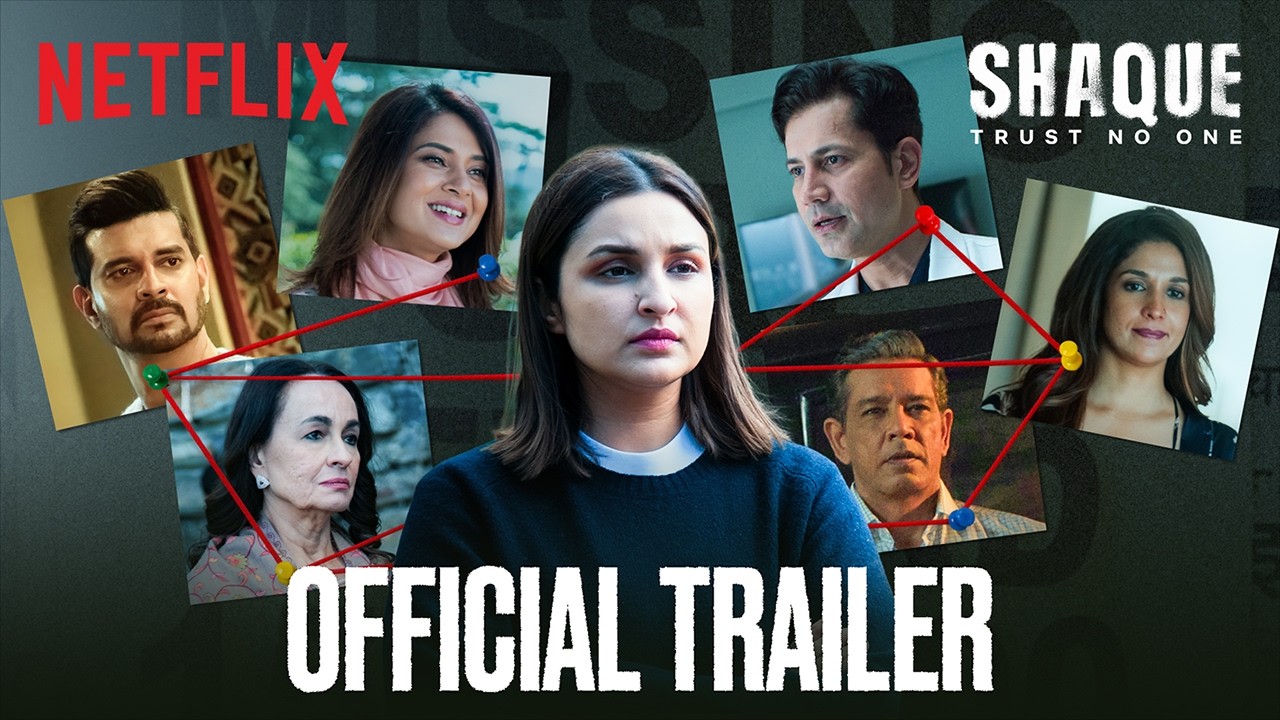

Shaque: Trust No One Review 2026 — Netflix’s Slow-Burn Shimla Mystery Or A Preposterous Seven-Hour Stretch?
Cinema Hook & Cultural Context
In the crowded Indian streaming marketplace of 2026, where every second Friday brings a new crime procedural vying for the elusive “binge-watch” crown, Netflix’s Shaque: Trust No One arrives with a distinct proposition — a seven-episode Hindi mystery thriller that trades the adrenaline-soaked bombast of mainstream commercial cinema for the cold, deliberate dread of a Scandinavian noir.
Set against the misty, pine-laden contours of Shimla, the series seeks to weaponize domestic paranoia, maternal obsession, and small-town claustrophobia into a slow-burning narrative furnace. What emerges, however, is one of the most fascinatingly divisive OTT releases of the year — a production that showcases genuine atmospheric craft and a committed central performance from Parineeti Chopra, yet simultaneously courts criticism for narrative bloat, logic-defying twists, and a kitchen-sink approach to social evils that threatens to drown its central emotional core.
The cultural context surrounding Shaque is inseparable from Parineeti Chopra’s career trajectory. This marks her high-profile OTT debut — a calculated pivot for an actress who, for much of the past decade, oscillated between breezy romantic comedies and underperforming big-budget vehicles. Her decision to headline a dark, psychologically grueling mystery for Netflix signaled an appetite for reinvention, echoing a broader industry migration where A-list Hindi film talent increasingly views streaming platforms not as a downgrade but as a legitimate creative playground.
The series also resurrects Jennifer Winget, a television juggernaut making a rare crossover into prestige streaming terrain, and positions Tahir Raj Bhasin — an actor who has quietly built an impressive filmography of antagonists and morally ambiguous men — in a rare “leading man with secrets” role.
Yet perhaps the most culturally resonant element of Shaque is its thematic spine: the weaponization of a mother’s grief. Indian popular culture has long sanctified the self-sacrificing mother — the Devi archetype who endures silently. Shaque deliberately fractures that archetype, presenting Anvita as a woman whose nine-year obsessive quest has corroded her into something far more complicated: a woman who is simultaneously sympathetic and destructive, a victim who becomes an aggressor, a seeker of truth who gaslights herself.
In an era where true-crime obsession and DNA-discovery reunions dominate headlines, the series taps into a deeply contemporary anxiety — what happens when faith, institutions, and even family become fundamentally unreliable?
Main Cast & Crew
Analysis: Visual Grandeur & Cinematography
From a purely technical standpoint, Shaque: Trust No One represents a significant aesthetic leap for Indian web content set in hill stations. The decision to shoot almost entirely on location in Shimla — rather than resorting to Manali backlots or generic Ooty substitutes — pays immediate dividends. The cinematography leans heavily into what can only be described as a “Scandinavian mystery aesthetic”: muted color grading dominated by slate greys, moss greens, and the pale amber of colonial-era lamplight; wide frames that emphasize the sheer verticality of the hills; and an almost tactile sense of cold, damp mountain air that seeps through the screen.
The production design team has constructed a “cold setting” — not merely in temperature but in emotional register — where the stately colonial bungalows and narrow winding lanes become characters themselves, their shadows hiding as much as they reveal.
The visual grammar of the series is deliberate in its slowness. Unlike the frenetic, jump-cut-heavy editing that defines most Indian crime procedurals, Shaque allows scenes to breathe. Long takes follow Anvita through corridors of her decaying marriage; the camera lingers on empty chairs and half-open doors, constructing a visual lexicon of absence and intrusion.
Quick Look Pooja Meri Jaan Movie 2026 HDHub4u bi | Release Status, Screen Counts, Theatrical Run & Buzz
This patience is both the series’ greatest artistic asset and, paradoxically, its commercial liability — because for every viewer seduced by the atmosphere, another will find the pacing enervating, mistaking deliberate slowness for narrative stalling.
The series also demonstrates sophisticated command over its hallucination sequences. When Anvita’s psychological state begins to fracture, the visual language shifts — the color temperature drops, focus becomes shallow, and framing becomes increasingly claustrophobic. These moments are genuinely unsettling, and they suggest that director Rensil D’Silva has absorbed lessons from psychological horror cinema as much as from whodunit television.
The problem, however, is one of calibration. Critics have rightly noted that the series frequently “veers into campy and preposterous territory” — a consequence of moments where the visual ambition outstrips the script’s logical foundation. A policeman barging into an active operation theatre, for instance, is staged with the same atmospheric seriousness as a genuinely chilling discovery, creating tonal dissonance that undermines the carefully constructed dread.
The sound design deserves specific mention. The series eschews a bombastic background score in favor of ambient sound — the creak of floorboards, the distant whistle of a toy train, the persistent percussion of rain against windows. This sonic restraint amplifies tension in ways that a traditional orchestral score could not.
However, the lack of a clearly identifiable musical identity — the composer remains officially unconfirmed — means the series lacks a memorable aural signature, the kind of haunting theme that would elevate it from “well-made” to “iconic.” The production design’s cold palette and the cinematography’s atmospheric ambitions are ultimately in service of a story that, at 4 hours 40 minutes, stretches its central mystery dangerously thin.
Target Demographic & Screen Count Estimation
The target demographic analysis reveals a fascinating strategic divergence. Netflix India has clearly positioned Shaque not as a mass-market crowd-pleaser but as a niche “prestige paranoia” product aimed squarely at the same audience that devoured Delhi Crime, Paatal Lok, and international fare like The Killing and Broadchurch.
The female-skewing focus is deliberate — both Parineeti Chopra and Jennifer Winget command significant female viewership, and the central narrative of maternal obsession is designed to resonate with mothers who will recognize Anvita’s terror, even if they cannot condone her methods. The series also strategically targets the “couple viewing” segment — mysteries are among the most co-viewed genres on streaming platforms, and a husband-wife dynamic at the story’s core provides natural conversational fodder.
The absence of any theatrical footprint is, of course, by design rather than deficit. As a commissioned Netflix Original produced by Alchemy Films, Shaque was never intended for the big screen. This has significant implications for how we evaluate its commercial performance. Traditional box-office metrics — opening day occupancy, screen count, breakeven footfall — are meaningless here.
In Focus Pehla Pyaar Doosri Baar Movie 2026 HDHub4u bi | Release Status, Screen Counts, Theatrical Run & Buzz
Instead, the series will be judged by Netflix’s internal metrics: completion rate (what percentage of viewers who start episode one finish all seven), total streaming hours in the first 28 days, and subscriber acquisition/retention contribution. Industry estimates suggest that for a Hindi Original of this scale, a successful run would require the series to enter Netflix India’s weekly Top 10 for at least two consecutive weeks and generate over 15 million viewing hours globally in its debut month.
The demographic targeting also reveals a potential weakness. By skewing so heavily toward urban, English-comfortable, “prestige TV” audiences, the series risks alienating the massive Hindi heartland viewership that drives hits like Mirzapur and Scam 1992. The Shimla setting, while aesthetically distinctive, lacks the visceral, recognizable “Indianness” of a Mumbai underworld saga or a small-town Uttar Pradesh crime epic.
This is a mystery designed for viewers who appreciate ambiguity and psychological complexity — a demographic that, while influential and critically loud, is significantly smaller than the mass-market base that fuels India’s biggest streaming success stories. Whether this trade-off was a deliberate artistic choice or a miscalculation will only become clear as streaming data accumulates.
Commercial Economics & Box Office Breakdown
Because Shaque: Trust No One is a direct-to-OTT Netflix Original, traditional box-office economics do not apply. There are no ticket sales, no distributor shares, no exhibitor splits, and no theatrical trade verdict. The entire commercial model rests on Netflix’s subscription-driven ecosystem, where the value of the series is measured not in rupees earned per ticket but in subscriber engagement, retention, and brand equity for the platform.
This fundamentally alters how we must evaluate the show’s “success” or “failure.” A film that earns ₹100 crore theatrically is an unambiguous hit; a streaming series that generates 20 million viewing hours is harder to assess, because Netflix does not publicly disclose its content ROI metrics.
Nevertheless, we can construct a reasonable commercial framework. Netflix India has been aggressively investing in Hindi Originals since 2018, with per-series budgets reportedly ranging from ₹15 crore to ₹60 crore depending on scale, star power, and production values. Shaque, with its established cast (Parineeti Chopra, Tahir Raj Bhasin, Jennifer Winget), extensive on-location Shimla shoot, and seven-episode structure, likely falls in the mid-to-upper range of this spectrum, potentially in the ₹25–40 crore bracket.
Marketing spend — including the trailer launch, social media campaigns, and Netflix’s in-app promotional placements — would add another ₹5–10 crore. Against this, Netflix measures success not through direct revenue but through the series’ ability to attract new subscribers, reduce churn, and generate the kind of cultural conversation that reinforces the platform’s position as the home of premium Indian content.
The critical and audience reception complicates this calculus significantly. With most trade critics panning the series — Filmfare’s 3.5/5 being a notable outlier, while t2ONLINE and Aaj Tak delivered scathing dismissals — the word-of-mouth trajectory is unfavourable. In the streaming era, opening weekend performance is driven by marketing and star power, but sustained viewership depends almost entirely on organic recommendation.
Top Story Dupahiya Season 2 Movie 2026 HDHub4u bi | Release Status, Screen Counts, Theatrical Run & Buzz
A series that generates more “eye roll” than “edge of seat” reactions will see its completion rate drop precipitously after the first two or three episodes. For a seven-episode mystery, a low completion rate is particularly damaging, because the entire narrative structure relies on viewers reaching the finale to experience the reveal.
The production economics also illuminate a broader industry trend: the “stretch to seven” problem. Aaj Tak’s review astutely noted that Shaque‘s story could have been a “two-hour tight film” stretched into seven episodes. This is a systemic issue in Indian streaming, where the pressure to deliver “bingeable” multi-episode content often leads to narrative padding.
For Netflix, this creates a quality-control dilemma: longer series mean more viewing hours (good for engagement metrics) but also greater risk of viewer fatigue and negative word-of-mouth (bad for long-term retention). The sweet spot — a tight, four-to-five-episode arc — remains elusive for many Indian creators, and Shaque‘s bloat is a textbook example of this miscalculation.
The series’ ultimate commercial success will therefore hinge on whether Netflix’s algorithm-driven recommendation engine can sustain viewership despite the critical drubbing, or whether the show becomes another cautionary tale about the perils of prioritizing quantity over narrative economy.
Today’s Reviewers Pulse
The critical reception for Shaque: Trust No One represents one of the most sharply divided verdicts of the 2026 streaming calendar. The consensus is not merely mixed — it is bifurcated, with a minority of critics defending the series’ atmospheric ambitions and a vocal majority condemning its narrative incoherence. Filmfare’s 3.5/5 rating stands as the most generous major assessment, with the critic praising the “atmospheric quality,” the performances (specifically singling out Jennifer Winget as a “surprise package”), and the slow-burn feel that evoked comparisons to Scandinavian mysteries.
Crucially, however, even this positive review contained caveats — the series “feels longer than it needs to be,” and the plot “deliberately holds back information just to prolong the mystery.” This is the central tension: the series knows how to create mood but not how to sustain narrative momentum.
The negative reviews are notably more visceral in their criticism. t2ONLINE’s assessment as a “bargain-basement thriller” that is “just silly” captures the frustration of critics who felt the series squandered its potential. The review’s specific complaints — “eye roll-inducing twists,” “sketchy cardboard cutout players,” and a script that “sacrifices a credible plot” — point to fundamental storytelling failures rather than mere stylistic disagreements.
The observation that ridiculous scenes (like a policeman barging into an operation theatre) generate “more giggles than gasps” is particularly damning for a series that clearly aspires to be taken seriously as a psychological thriller. Aaj Tak’s 2/5 verdict reinforced this, describing the plot as an overstuffed mixture of “kidnapping, surrogacy, infidelity, and tantrism” that loses its essential “curiosity” by the second or third episode, turning “suspense” into a “test of patience.”
Recommended HDHub4u Mysaa Movie 2026 | Release Status, Screen Counts, Theatrical Run & Buzz
The one near-unanimous point of praise centers on Parineeti Chopra. Several critics, even those who panned the series overall, acknowledged that she delivers a convincing performance as a grief-stricken mother, carrying the emotional weight of the show with commitment. This creates an interesting critical paradox: the series is routinely described as a failure, yet its lead performance is described as a success.
This suggests that the problems lie not in the casting or the performances but in the writing, pacing, and structural decisions. The actors are doing their best with material that ultimately cannot support them.
“The series brings more giggles than gasps — a fatal flaw for a thriller that positions itself as a slow-burn psychological study.” — Trade critical consensus
The audience word-of-mouth appears to mirror the critical pans. While Parineeti Chopra’s husband, Raghav Chadha, publicly praised the series as “genuinely gripping” and “nail biting” — a spousal endorsement that naturally carries limited critical weight — general audience reception on streaming platforms has been mixed to negative.
Common complaints echo the critics: illogical plot twists, stretched narrative, and a resolution that fails to justify the seven-episode investment. In the streaming ecosystem, where viewer reviews on platforms like IMDb and social media discussions on X (formerly Twitter) and Reddit can dramatically influence a show’s longevity, this negative consensus poses a significant challenge for Netflix’s efforts to position Shaque as a must-watch title.
Frequently Asked Questions
Is Shaque: Trust No One based on a true story?
No, Shaque: Trust No One is a work of fiction. The series is an original screenplay created by Rensil D’Silva and Siddharth P. Malhotra, produced under the Alchemy Films banner for Netflix. While the narrative draws on universal anxieties about child abduction and maternal obsession, it is not based on any specific real-life case.
The Shimla setting and the story’s exploration of superstition, illegal surrogacy, and medical malpractice are dramatic constructions designed to serve the mystery-thriller genre rather than document actual events.
Where can I watch Shaque: Trust No One and how many episodes are there?
Shaque: Trust No One is streaming exclusively on Netflix as a commissioned Original series. It comprises seven episodes, with individual runtimes averaging between 35 and 43 minutes, totalling approximately 4 hours and 40 minutes. The series premiered on September 24, 2026, and is available in Hindi with subtitles and dubbed options across Netflix’s global territories.
Trade Alert HDHub4u Drishyam The Conclusion Movie 2026 | Release Status, Screen Counts, Theatrical Run & Buzz
There is no theatrical or satellite television release for this title.
What is the story of Shaque: Trust No One about?
The series follows Anvita, a mother whose newborn daughter Apeksha was abducted from a Shimla hospital nine years ago. Each year on her daughter’s birthday, Anvita receives mysterious photographs of the missing girl, fuelling her obsessive search. As she investigates, every person around her — her husband Alok, her best friend Shreya, her mother-in-law Madhu, and a new neighbour named Sakshi — becomes a suspect.
The narrative expands to encompass illegal surrogacy, superstition, witchcraft, and child sacrifice, blurring the line between Anvita’s intuition and her increasingly fragile mental state.
Is Shaque: Trust No One suitable for children?
No, Shaque: Trust No One carries an NC16 rating (Netflix’s Singapore-tier classification, which approximately corresponds to a mature audience advisory in India). The series contains themes of child abduction, psychological trauma, hallucinations, and references to disturbing social evils including child sacrifice. The tone is dark, atmospheric, and frequently unsettling.
It is not recommended for viewers under 16 and may be distressing even for sensitive adult viewers, particularly parents of young children.
Who plays the lead role in Shaque: Trust No One?
Parineeti Chopra plays the lead role of Anvita, marking her OTT debut. She is supported by Tahir Raj Bhasin as her husband Alok, Jennifer Winget as the mysterious new neighbour Sakshi, Soni Razdan as mother-in-law Madhu, Anup Soni as Inspector Khurana, Sumeet Vyas as Dr. Bhaskar, Harleen Sethi as Shreya, and Dhruv Chowdhary as Gaurav.
The series is directed by Rensil D’Silva and produced by Alchemy Films for Netflix.
Why did Shaque: Trust No One receive negative reviews?
The negative critical consensus stems from several interconnected issues. First, the seven-episode structure stretches a story that critics believe could have been told in a two-hour film, leading to narrative padding and loss of momentum. Second, the plot incorporates too many disparate elements — kidnapping, surrogacy, infidelity, tantrism, witchcraft — creating an overstuffed narrative that dilutes the central mystery.
Third, several scenes defy credibility, generating unintentional comedy rather than tension. Fourth, the series withholds information artificially to prolong suspense rather than organically building mystery. While Parineeti Chopra’s performance was praised and the Shimla-shot cinematography was noted for its atmosphere, these strengths could not compensate for the structural and writing deficiencies identified by most reviewers.
Data Attribution Registry
- Netflix: Everyone’s a Suspect, No One’s Innocent — ‘Shaque: Trust No One’ Premieres September 24 on Netflix – https://about.netflix.com/en/news/everyones-a-suspect-no-ones-innocent-shaque-trust-no-one-premieres-september-24-on-netflix
- t2ONLINE: Review: Shaque: Trust No One aims to be a campy thriller, but is just silly – https://t2online.in/screen/streaming/review–shaque–trust-no-one-aims-to-be-a-campy-thriller–but-is-just-silly/2008222
- Filmfare: Shaque: Trust No One Review: Slow-burn Mystery – https://www.filmfare.com/reviews/bollywood-movies/shaque-trust-no-one-review-slow-burn-mystery-86179.html
HDHub4u Media Integrity
The cinematic data, buzz metrics, and box office forecasts published above have been curated independently by our editorial team. We firmly support the theatrical industry and do not host or encourage unauthorized media downloads.
Media Notice: All box office figures and release details for Shaque Movie 2026 HDHub4u bi | Release Status, Screen Counts, Theatrical Run & Buzz are compiled from verified industry trackers and official distributors.


