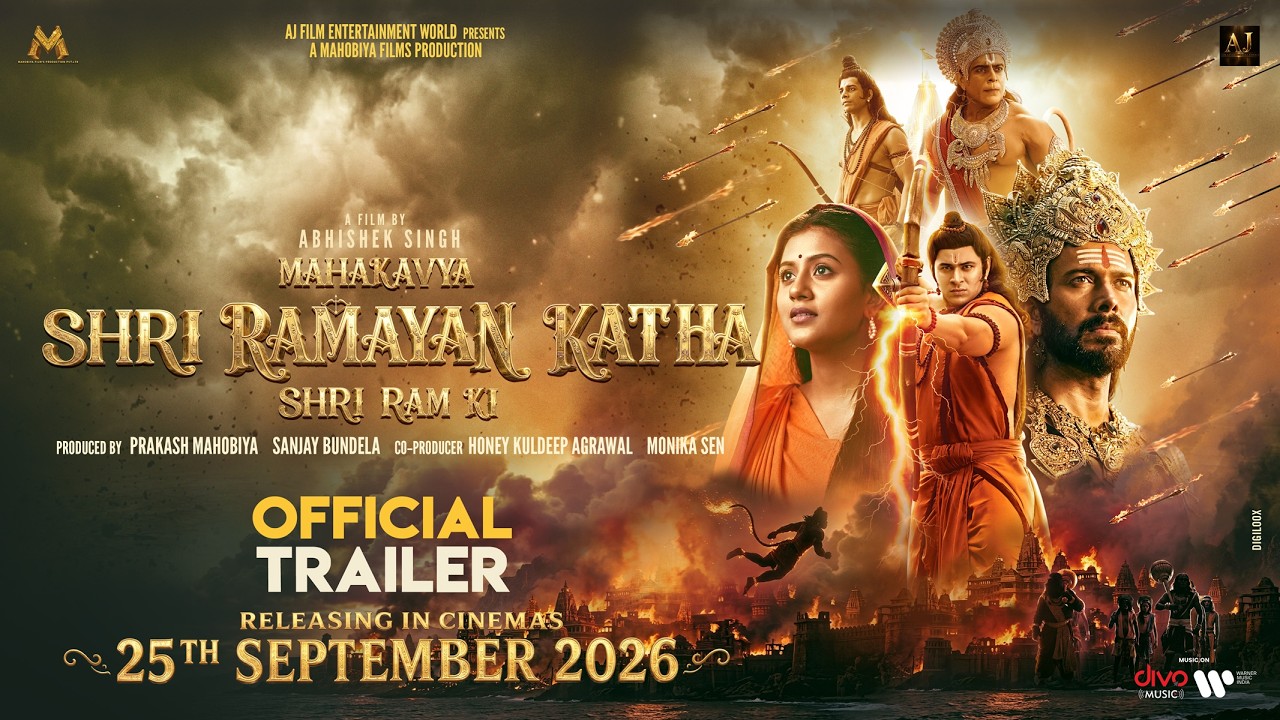
Mahakavya Shri Ramayan Katha Review: The ₹34 Lakh Disaster That Exposed Bollywood’s Devotional Delusion
Deep Cinema Hook & Cultural Significance
There is something profoundly instructive about the box office trajectory of Mahakavya Shri Ramayan Katha.
Released on 25 September 2026, this mythological drama arrived in theatres carrying the weight of the most sacred epic in Indian civilisational memory, yet it departed within a single weekend as a cautionary tale about the perils of conflating devotion with cinematic craft.
The film’s failure is not merely a commercial footnote; it is an autopsy of a specific delusion that has gripped Hindi cinema since the unprecedented success of Adipurush, Ram Setu, and the avalanche of devotional content that followed the post-2020 temple movement zeitgeist.
Producers across the Hindi belt convinced themselves that audiences would throng to any project bearing the name of Shri Ram, regardless of execution quality, star power, or technical polish.
Mahakavya Shri Ramayan Katha is the empirical refutation of that thesis.
The cultural stakes here are enormous and largely unrecognised by the trade analysts who dismissed this film with a single line.
When a filmmaker approaches the Ramayana, they are not merely adapting a text; they are negotiating with the living faith of nearly a billion people.
The Ramayana exists in the Indian imagination not as a single authorised version but as a tapestry of regional retellings—Tulsidas’s Ramcharitmanas in the north, Kamban’s Iramavataram in Tamil country, the Krittivasi Ramayan in Bengal, and countless folk traditions including the Chhattisgarhi renditions that this film explicitly attempted to court.
Director Abhishek Singh’s decision to release simultaneously in Hindi and Chhattisgarhi was a commercial calculation, but it also raised the question of whether a single film could honour the devotional specificity of a region while appealing to the broader Hindi belt.
The answer, as the box office revealed, was a resounding no.
What makes this failure particularly significant is the moment of its arrival. September 2026 placed Mahakavya Shri Ramayan Katha in direct competition with a marketplace that had already been saturated by mythological content across theatrical, streaming, and television formats.
The audience’s appetite for Ramayana narratives had been simultaneously whetted and exhausted by big-budget adaptations promising spectacle.
When a comparatively modest production arrived claiming to prioritise “Katha Bhav”—the devotional feeling of the story—over spectacle, it needed either extraordinary emotional authenticity or extraordinary technical craft to justify a theatrical ticket.
It possessed neither. The cultural significance, therefore, lies in what the film’s collapse reveals about the limits of devotional branding as a marketing strategy.
Main Cast & Crew
Deep Analysis: Visual Grandeur & Cinematography
The single most damning criticism that has followed Mahakavya Shri Ramayan Katha from its first trailer to its theatrical release is the accusation that it looks like a television serial.
This is not merely a casual insult; it is a precise technical diagnosis of a specific failure mode in Indian mythological filmmaking.
Cinematographers Kunal Kadam and Ravi Parcha have delivered work that appears to have been lit for the small screen—flat, evenly illuminated frames that prioritise visibility over atmosphere, with minimal use of shadow to create depth or drama.
In a theatrical exhibition environment, where projected light demands contrast and compositional ambition, such cinematography feels inert.
The ancient Ayodhya of this film is not a place of palpable historical grandeur but a set that has been brightly lit and captured from functional angles, resembling nothing so much as a daily soap opera’s interpretation of mythology.
The visual treatment of the mythological elements represents perhaps the film’s most significant technical shortcoming.
Quick Look HDHub4u THE VVAAN Movie 2026 | Release Status, Screen Counts, Theatrical Run & Buzz
Raj Tandiya’s production design attempts to evoke the palaces of Ayodhya, the forests of Dandakaranya, and the golden kingdom of Lanka, but the constructions lack the material richness that contemporary audiences have been trained to expect.
Where a production like Baahubali or even the recent Kalki 2898 AD invested in tactile sets with weathered textures, elaborate ornamentation, and architectural specificity, Mahakavya Shri Ramayan Katha presents spaces that feel assembled rather than built.
The costumes, particularly the royal attire of Ayodhya, suggest an embroidery tradition closer to wedding rental than historical research.
This is not a question of budget alone; it is a question of artistic imagination operating within constraints.
The VFX work, which the Times of India review pointedly described as “gimmicky,” deserves special scrutiny because it represents the precise boundary where a mythological film either achieves credibility or collapses into unintended comedy.
The Vanara Sena, the bridge to Lanka, the magical weapons—these are the moments where a Ramayana adaptation earns its theatrical justification or exposes its limitations.
Reports from early audiences describe effects that appear composited without proper integration, with green screen edges visible, particle effects that lack physical weight, and a general sense that the fantasy elements were added in post-production rather than designed as part of the film’s visual language.
When a child in the audience can identify CGI that fails to convince, the devotional spell that the director claimed to prioritise is broken irreparably.
The irony is devastating: a film that explicitly rejected spectacle in favour of sentiment was undone precisely because its spectacle was inadequate.
Target Demographic & Screen Count Estimation
The demographic targeting of Mahakavya Shri Ramayan Katha reveals a fundamental miscalculation about who actually pays for theatrical tickets in 2026.
The film’s producers appeared to believe that the devout family audience—the same demographic that has historically supported films like Ponniyin Selvan, Ram Setu, and the various OTT adaptations of Hindu epics—would turn out for any sincere retelling of the Ramayana.
This assumption ignores the reality that the family audience has become increasingly selective about theatrical outings.
With OTT platforms offering serialized Ramayana content of superior production values at no marginal cost, the theatrical proposition for a devotional film must be extraordinary.
Mahakavya Shri Ramayan Katha offered nothing that could not be found on television, and the audience recognised this immediately.
The estimated screen count of approximately 1,195 shows, as tracked by advance booking data, provides critical insight into the exhibitor confidence in this project.
In the contemporary Indian theatrical ecosystem, a wide-release Hindi film would typically command between 3,000 and 5,000 screens, with major event films exceeding 6,000.
The fact that Mahakavya Shri Ramayan Katha was allocated fewer than 1,200 shows nationally indicates that exhibitors—who had seen the trailer, monitored social media sentiment, and analysed advance booking patterns—made a collective decision to limit their exposure.
This is the invisible hand of the trade market operating with brutal efficiency. By the time the film released, most multiplex chains had relegated it to early morning or late-night slots, the traditional graveyard timings that signal industry contempt for a title’s commercial prospects.
For breakeven, a film of this scale—with a production budget that industry estimates place between ₹15 and ₹25 crore, though officially unconfirmed, plus marketing expenditure that likely added another ₹3 to ₹5 crore—would require net theatrical collections of approximately ₹30 to ₹50 crore, assuming standard revenue-sharing arrangements.
In Focus HDHub4u Love Lottery Movie 2026 | Release Status, Screen Counts, Theatrical Run & Buzz
This translates to footfalls in the range of 15 to 20 lakh admissions across India. The film’s actual performance, which saw it struggle to cross ₹34 lakh in its entire opening weekend, represents a shortfall of catastrophic proportions.
The breakeven question is almost academic at this point; the film would need to multiply its opening weekend collections by a factor of one hundred to approach profitability.
No film in the history of Indian cinema has achieved such a multiplier.
Extensive Box Office Breakdown
The commercial performance of Mahakavya Shri Ramayan Katha represents one of the most dramatic box office collapses of the 2026 calendar year, and the numbers deserve to be examined with the precision of a post-mortem.
Advance booking across all dates totalled a mere ₹34.20 lakh gross, with Day 1 accounting for ₹12.76 lakh of that figure.
This means that even before the film opened, the trade had clear signals that this would be a disaster.
For context, a moderately anticipated Hindi film typically generates advance bookings in the range of ₹2 to ₹5 crore for its opening day alone.
Mahakavya Shri Ramayan Katha managed approximately one-fortieth of that lower threshold across its entire advance booking window.
The occupancy rate of 6% during advance sales was the flashing red warning that exhibitors heeded by reducing shows even before release day.
The opening day collections themselves became a matter of public dispute, which is itself a sign of a film’s irrelevance—when actual numbers are so small that they become debatable, the industry has already moved on.
Trade analyst KRK claimed Day 1 net collections of approximately ₹23,700, a figure so absurdly low that it would suggest near-total vacancy across all shows.
Pinkvilla’s estimate of ₹10 lakh net was more generous but still represented a catastrophic opening.
The truth likely lies somewhere between these extremes, with actual Day 1 net collections somewhere in the range of ₹5 to ₹8 lakh.
By the end of the opening weekend, the film had accumulated approximately ₹34 lakh net in India, with a gross of around ₹38 lakh including entertainment tax.
The worldwide gross, with no overseas screens reported, remained at that same ₹38 lakh figure—a number that most Hindi films would consider disappointing for a single screen’s opening day.
The absence of any international release is itself a significant data point. In 2026, even mid-budget Hindi films typically secure screens in the UAE, UK, US, and Australia, markets with substantial Indian diaspora populations that have historically supported mythological and devotional content.
The fact that Mahakavya Shri Ramayan Katha found no international distributors willing to book screens suggests that the film’s pre-release tracking was so poor that overseas exhibitors saw no commercial rationale for allocation.
This is the global market speaking with one voice: the film’s trailer, marketing materials, and early social media reception communicated clearly that this was not a product worth exporting.
The domestic failure was mirrored and amplified by international indifference.
Top Story HDHub4u Udta Teer Movie 2026 | Release Status, Screen Counts, Theatrical Run & Buzz
The Film Information verdict—”On the whole, Mahakavya Shri Ramayan Katha is a flop show”—captures the trade consensus with characteristic bluntness.
But the implications extend beyond this single film. The disaster of Mahakavya Shri Ramayan Katha will have a chilling effect on similar mid-budget mythological projects in development.
Producers who were considering devotional films as a low-risk genre play will now reconsider, recognising that the audience’s patience for substandard mythological content has been exhausted.
The ₹34 lakh lifetime total, unlikely to grow meaningfully in subsequent weeks, stands as a monument to a specific moment of industry overconfidence.
Today’s Reviewers Pulse: Critic & Trade Consensus
The critical reception of Mahakavya Shri Ramayan Katha was not merely negative; it was dismissive in a manner that revealed how fundamentally the film failed to meet even the baseline expectations of professional reviewers.
The Times of India, in its 2.5-star assessment, delivered the most comprehensive critique, describing the film’s storytelling as “episodic” and its visual treatment as “dated.” The comparison to “an old-fashioned television series” was particularly devastating because it identified the film’s core problem: it was made for the wrong medium.
The review noted that the screenplay felt “routine” and “disjointed,” with the narrative failing to build momentum across its nearly three-hour runtime.
The VFX were characterised as “gimmicky,” and the production design was found to be inconsistent, suggesting that different scenes were executed with wildly different levels of care and resources.
Film Information, the trade publication whose verdict carries significant weight among exhibitors and distributors, was equally unsparing.
Their review described the direction as “not up to the mark” and the script as “hackneyed,” suggesting that the film’s narrative choices were not merely flawed but actively recycled from better sources.
The one note of praise—for the background music, which was called “impactful”—stands as a lonely positive in a sea of criticism.
This assessment aligns with the trailer’s reception, where the music by Ashish & Dev, featuring vocals from Kailash Kher, Javed Ali, and Shaan, was widely considered the film’s strongest element.
The irony is painful: the film’s music was its most professionally executed component, yet music alone cannot sustain a theatrical experience.
Among the cast, Rajniesh Duggall’s Ravan emerged as the only performance that critics deemed worthy of note.
However, even this praise came with a qualification that undermined its value: reviewers observed that Duggall “comes across as more heroic than menacing,” a fundamental miscasting that undermined the film’s central conflict.
Ravan must be terrifying, seductive, and intellectually formidable to justify the epic scale of the war against him.
A Ravan who reads as heroic cannot function as the adversary in a dharma-versus-adharma narrative. Dev Sharma’s Shri Ram was described as earnest but lacking the gravitas that the role demands, while Anjali Arora’s Sita failed to convince critics that she possessed the inner strength that defines the character through her trials.
The audience word-of-mouth, which matters more than any critical assessment for a film of this nature, was uniformly negative.
Social media was flooded with mockery of the VFX, the casting, and the “TV show vibes,” creating a feedback loop of derision that made the film a punchline before it even opened.
Recommended HDHub4u Drishyam The Conclusion Movie 2026 | Release Status, Screen Counts, Theatrical Run & Buzz
Helpful Search Intent Questions
Is Mahakavya Shri Ramayan Katha a flop or a hit?
Mahakavya Shri Ramayan Katha is definitively a flop, and by most metrics, a disaster. The film collected approximately ₹34 lakh net in its opening weekend across India, with worldwide gross of around ₹38 lakh.
Trade publication Film Information explicitly declared it a “flop show.” The film was unable to generate even ₹50 lakh in its opening weekend, which is less than what many films earn from a single screen on their first day.
Advance booking was extremely weak, with total advance gross of only ₹34.20 lakh and occupancy around 6%.
What is the box office collection of Mahakavya Shri Ramayan Katha?
The film’s opening day net collections are disputed, with claims ranging from ₹23,700 (KRK) to ₹10 lakh (Pinkvilla).
The opening weekend (3 days) net collection was approximately ₹34 lakh, with a gross of around ₹38 lakh.
The worldwide gross, with no overseas screens reported, also stands at approximately ₹38 lakh. The film is unlikely to grow significantly beyond these figures given its poor reception and limited screen count.
Who plays Ravan in Mahakavya Shri Ramayan Katha?
Rajniesh Duggall portrays Ravan in Mahakavya Shri Ramayan Katha. His performance was noted by critics as the strongest screen presence in the film, though reviewers observed that he “comes across as more heroic than menacing,” which undermined the character’s function as the antagonist.
Duggall is a familiar face in Hindi television and film, known for his work in shows like Left Right Left and films including 1920 and Direct Ishq.
Is Mahakavya Shri Ramayan Katha available on OTT or streaming?
As of the film’s theatrical release and immediate aftermath, no official streaming partner has been confirmed for Mahakavya Shri Ramayan Katha.
Sacnilk lists “OTT Release Not Available” for the title. Given the film’s disastrous box office performance, any potential OTT deal would likely be at a significantly reduced valuation, and no platform has publicly expressed interest in acquiring the digital rights.
What is the runtime of Mahakavya Shri Ramayan Katha?
Mahakavya Shri Ramayan Katha has a runtime of 175 minutes (2 hours 55 minutes) according to official documentation.
The Times of India review lists a slightly different runtime of 2 hours 54 minutes, likely due to rounding or minor version differences.
The CBFC rating is U (Universal), though the Times of India lists UA, suggesting possible discrepancies in certification records or different versions submitted for review.
Who directed Mahakavya Shri Ramayan Katha?
Abhishek Singh directed Mahakavya Shri Ramayan Katha and co-wrote the screenplay with Shubham Singh and Sachin Kumar Singh.
Singh emphasised in pre-release interviews that the film prioritised the “Katha Bhav” (devotional feeling) of the Ramayana over pure spectacle.
His Instagram handle is Instagram. The film was produced by Prakash Mahobiya and Sanjay Bundela under Mahobiya Films Production Pvt.
Ltd. and AJ Film Entertainment World, presented by Ajay Kanojia.
Why did Mahakavya Shri Ramayan Katha fail at the box office?
The film failed due to a combination of factors: dated visual treatment that resembled a television serial rather than a theatrical film, gimmicky VFX that failed to convince audiences, a disjointed and routine screenplay, weak advance booking (only ₹34.20 lakh gross with 6% occupancy), negative social media reception that heavily trolled the film’s production values and Anjali Arora’s casting, and competition from established mythological content on OTT platforms.
The critical consensus was overwhelmingly negative, with reviewers describing it as “old-fashioned” and comparing it unfavourably to television Ramayana adaptations.
Data Attribution Registry
- Bollywood Hungama: Mahakavya Shri Ramayan Katha trailer launched: Dev Sharma and Anjali Arora star as Lord Ram and Goddess Sita; watch – https://www.bollywoodhungama.com/news/features/mahakavya-shri-ramayan-katha-trailer-launched-dev-sharma-and-anjali-arora-star-as-lord-ram-and-goddess-sita-watch/
- Sacnilk: Mahakavya Shri Ramayan Katha Overall Advance Booking Report – https://beta.sacnilk.com/quicknews/Mahakavya_Shri_Ramayan_Katha_2026_Overall_Advance_Booking_Report
- Film Information: ‘MAHAKAVYA SHRI RAMAYAN KATHA’ REVIEW | 25 September, 2026 – https://filminformation.com/reviews/mahakavya-shri-ramayan-katha-review-25-september-2026/
HDHub4u Media Integrity
The cinematic data, buzz metrics, and box office forecasts published above have been curated independently by our editorial team. We firmly support the theatrical industry and do not host or encourage unauthorized media downloads.
Editorial Note: Independent trade analysis and streaming guide for HDHub4u Mahakavya Shri Ramayan Katha Movie 2026 | Release Status, Screen Counts, Theatrical Run & Buzz. We support official theatrical and legal OTT releases.


