Ranabali Hindi (2026) Box Office Prediction, Budget & Screen Count: Can Vijay Deverakonda’s 19th-Century War Epic Smash The ₹100 Crore Ceiling?
Cinema Hook & Cultural Context: Why This Period War Saga Matters
Indian cinema has always harboured a deep, almost spiritual fascination with the rebellion—the lone warrior who rises from the dust of a forgotten village to challenge an empire that believes itself invincible. In 2026, that fascination finds its most ambitious expression yet in Ranabali, a Hindi-language period action drama that transports audiences to the blood-soaked decades between 1854 and 1878, an era when colonial extraction was not an abstract policy but a daily, lived horror for millions across the subcontinent.
The film arrives at a fascinating inflection point in the pan-India marketplace, where mass action spectacles rooted in regional folklore have repeatedly demonstrated that audiences will embrace stories of indigenous resistance when they are mounted with scale, conviction, and emotional urgency. Ranabali positions itself squarely within that lineage, but its aspirations appear grander—it wants to be both a visceral crowd-pleaser and a myth-making exercise in historical memory.
The cultural context surrounding this release cannot be overstated. The story of Shinganamala Bobbili Ranabaali is drawn from the fertile soil of Telugu resistance lore, a cinematic tradition that has previously delivered thundering period epics celebrating warriors who defied imperial might. What distinguishes Ranabali in the current landscape is its deliberate pan-India positioning—shot and presented to transcend linguistic boundaries, headlined by two of the most bankable young stars in the country, and scored by a music duo whose anthems have a proven track record of burrowing into the national consciousness.
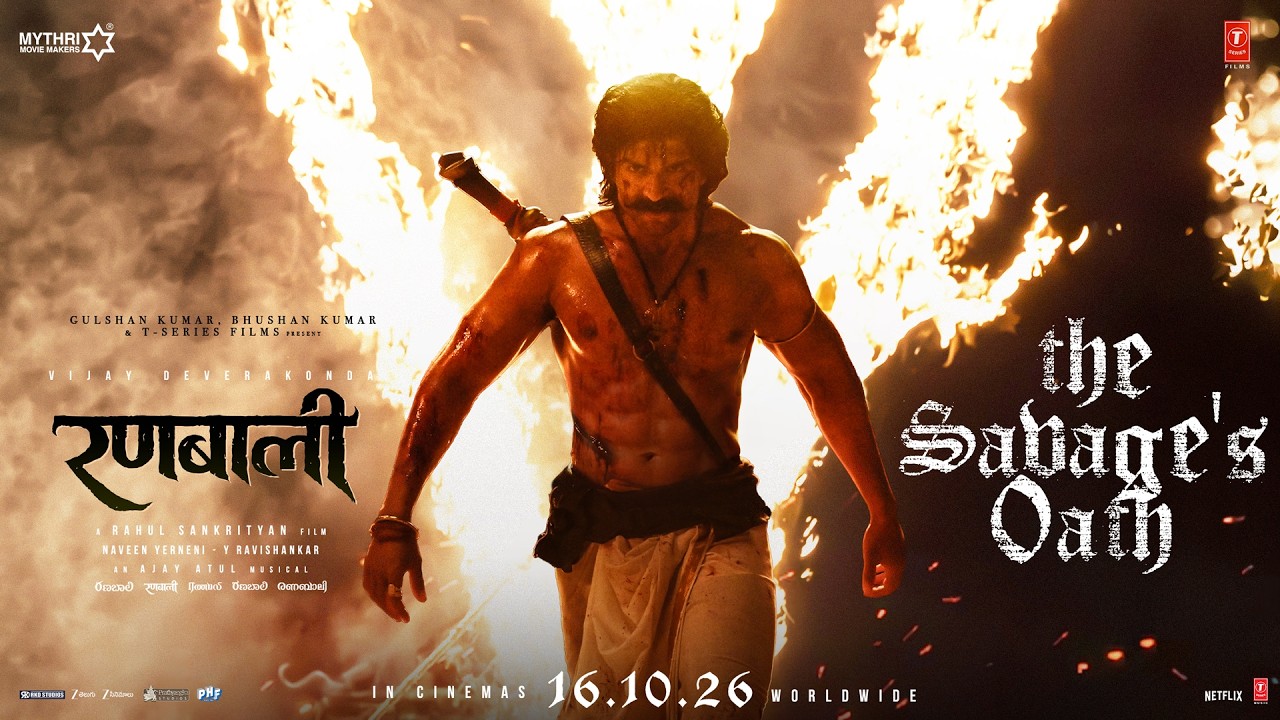
The promotional materials have leaned heavily into the concept of the “Savage’s Oath,” a provocative reclamation of the dehumanising language colonisers once deployed against freedom fighters. This is not merely marketing rhetoric; it signals a film that wants to engage with the psychology of oppression and the moral legitimacy of violent resistance.
Moreover, the timing feels almost eerily resonant. Audiences in 2026 are consuming historical narratives with renewed appetite, hungry for stories that connect present-day identities to past struggles. The film’s framing of colonial exploitation—referencing the staggering toll of lives lost and wealth extracted—taps into a collective historical consciousness that has been increasingly central to public discourse.
Ranabali is not simply selling tickets; it is selling catharsis, the promise of watching a wronged people strike back against overwhelming odds. Whether it delivers on that promise will determine whether it becomes a footnote or a phenomenon, but the cultural scaffolding around it is undeniably sturdy.
Main Cast & Crew: The Architects Behind The Epic
The assembly of this creative team reveals a production that has been engineered for maximum impact across India’s fragmented media landscape. Rahul Sankrityan, who has demonstrated a flair for narrating stories rooted in rural milieu and historical conflict, takes on what is unquestionably the most expensive and ambitious project of his career.
His challenge is formidable: to balance the intimacy of village life and personal relationships against the panoramic scale of colonial warfare, all while maintaining the tonal coherence that mass audiences demand from period spectacles. The director’s previous work suggests a sensibility that values emotional authenticity even within heightened genre frameworks, which bodes well for a narrative that must make audiences care about a 19th-century warrior’s oath as if it were their own.
Vijay Deverakonda’s transformation into the titular character has been the subject of intense fan speculation and trade curiosity since production began. The actor, whose career has oscillated between gritty urban dramas and larger-than-life commercial vehicles, appears to be betting heavily on Ranabali as his definitive pan-India statement.
The trailer showcased a physically formidable, emotionally volcanic presence—a warrior whose eyes carry both grief and fury, whose every gesture suggests a man who has been pushed beyond the limits of ordinary endurance. For Deverakonda, this role represents an opportunity to consolidate a fanbase that extends far beyond Telugu-speaking territories, to plant his flag in the Hindi heartland that has proven receptive to Southern imports when they deliver on scale and spectacle.
The casting of Rashmika Mandanna as Jayamma adds a crucial emotional dimension that transcends the typical romantic subplot. Mandanna, one of the very few actors to have achieved genuine pan-India stardom, brings an audience base that spans demographics and languages. More importantly, her role is positioned as “close to Ranabaali’s heart,” suggesting that Jayamma is not merely a decorative presence but an active participant in the narrative’s emotional architecture.
The creative choice to centre her character within the warrior’s motivation points to a film that understands something crucial about mass storytelling: audiences need a human face at the centre of the spectacle, a reason to invest beyond the choreography of battle. Her presence in the film has also attracted significant attention from streaming platforms, a factor whose commercial implications we will examine shortly.
Quick Look Main Na Raha Mera Movie 2026 HDHub4u bi | Release Status, Screen Counts, Theatrical Run & Buzz
The decision to cast Arnold Vosloo as the primary antagonist, Sir Theodore Hector, elevates the production’s ambitions considerably. Vosloo, internationally recognised for his work in films like The Mummy franchise, brings a gravitas and menace that could otherwise have been absent from a local production. His presence signals a desire to avoid caricature, to present the colonial adversary as a genuinely formidable force rather than a cardboard villain.
The dynamic between Deverakonda’s Ranabaali and Vosloo’s Sir Theodore will be crucial to the film’s success; if audiences believe in the threat, they will believe in the heroism required to confront it. Luke McGibney’s supporting role further expands the British colonial cast, suggesting a narrative that grants complexity and screen time to its antagonists.
The production banners attached to Ranabali tell their own story about commercial expectations. Mythri Movie Makers have established themselves as one of the most reliable production houses in Indian cinema, with a portfolio that includes massive critical and commercial successes. Their partnership with T-Series, the music and film empire that has perfected the art of pan-India marketing and distribution, creates a synergistic powerhouse.
The involvement of Ajay-Atul as composers is particularly significant—the duo’s ability to craft anthems that transcend individual films, that become part of the cultural fabric itself, could transform Ranabali from a successful film into a phenomenon. The track “O Mere Saajan” has already generated substantial interest, promising a musical dimension that could sustain the film’s presence in public consciousness well beyond its theatrical window.
Nirav Shah’s cinematography represents perhaps the most crucial technical element in translating the film’s grand ambitions to the screen. A period epic demands a visual language that can convey both the intimacy of personal moments and the overwhelming scale of historical forces. The promotional material has suggested a palette that oscillates between the dusty warmth of rural existence and the cold, imposing aesthetic of colonial power—a visual dichotomy that mirrors the film’s thematic concerns.
If Shah and Sankrityan have succeeded in creating a coherent visual world, Ranabali’s cinematic value will extend beyond narrative to encompass genuine artistic achievement. The absence of officially confirmed details regarding editor, action choreography, and production design is a minor frustration for trade observers, but the core creative team’s pedigree provides reasonable grounds for optimism.
Analysis: Visual Grandeur & Cinematography As Narrative Weapon
The period action epic is a genre that lives or dies on the believability and immersion of its world. Audiences have become increasingly sophisticated in their visual literacy, capable of discerning the difference between productions that use scale as a crutch and those that integrate it meaningfully into their storytelling.
Ranabali, positioned between 1854 and 1878, faces the particular challenge of depicting an era before mechanised warfare, where battles were fought with swords, spears, and muskets, where the physicality of combat carried a visceral immediacy that modern weaponry rarely replicates. The film’s visual strategy must communicate both the vastness of the colonial enterprise—its fortresses, its disciplined troops, its machinery of extraction—and the intimacy of village resistance, where every face is known, every loss is personal.
Early glimpses from the trailer suggest that Nirav Shah has approached this challenge with a twofold visual strategy. The colonial spaces appear bathed in cold, calculating light, their architecture dominating the frame with the confidence of power. By contrast, the scenes of Raju’s village and his people appear rendered with warmer tones, their faces shot with a closeness that conveys humanity and vulnerability.
This is not merely an aesthetic choice but a storytelling device: the audience is invited to understand the colonial world as spiritually empty despite its material grandeur, while the indigenous world, however materially impoverished, possesses the emotional richness that makes life worth defending. When these two visual worlds collide in action sequences, the film has the opportunity to create genuinely kinetic cinema that operates on both spectacle and meaning.
The question of how Ranabali handles combat choreography will be central to its reception with mass audiences. The trailer’s emphasis on physical confrontation—sword clashes, hand-to-hand combat, the visceral fury of man-to-man struggle—suggests a commitment to grounded, impactful action rather than the CG-heavy, physics-defying sequences that have become commonplace.
In Focus Bakaiti 2 Movie 2026 HDHub4u bi | Release Status, Screen Counts, Theatrical Run & Buzz
This is a risky choice in a marketplace where audiences have been conditioned to expect hyper-stylised set pieces, but it is also a potentially differentiating one. If Ranabali can deliver action that feels both brutal and beautiful, that respects the physical realities of its historical setting while still providing the catharsis of watching a hero overcome impossible odds, it will have carved out a distinctive identity in a crowded genre space.
The cinematographic approach also has implications for how the film’s thematic content lands with audiences. A period epic about colonial exploitation risks becoming overly didactic, a history lesson dressed in entertainment clothing. Shah’s camera must be an active participant in the storytelling, using composition and movement to communicate ideas that dialogue cannot.
The close-ups of Deverakonda’s face that the trailer foregrounds—his eyes burning with determination and grief—represent the film’s emotional core. The wide shots of colonial formations and village landscapes establish the political and spatial dynamics that drive the narrative. If these visual elements are interwoven with the narrative rather than merely accompanying it, Ranabali can transcend its genre trappings to become something more resonant.
The production’s decision to shoot in what appears to be authentic locations rather than relying solely on sets or digital environments also merits attention. Period authenticity has become a marker of quality in the Indian epic film, a way of signalling that the production is serious about its historical engagement. The dusty terrain, the period-appropriate clothing and weaponry, the attention to the textures of 19th-century rural life—these details accumulate into a world that feels lived-in rather than fabricated.
For international audiences, particularly those who encounter the film through streaming platforms, this authenticity will be crucial to the film’s credibility. For domestic audiences, it provides the immersive quality that defines the difference between merely watching a film and experiencing it.
Target Demographic & Screen Count Estimation
The demographic targeting of Ranabali reveals a film that has been strategically designed to maximise its addressable audience across India’s diverse theatrical landscape. The primary target—mass single-screen centres—represents the traditional heartland of commercial Indian cinema, the territories where star power and spectacle still translate most reliably into ticket sales.
These audiences have historically been the first to embrace films that combine action, emotion, and larger-than-life heroism, and Ranabali’s DNA is engineered for precisely this constituency. Vijay Deverakonda’s fanbase, cultivated through a career that has consistently delivered films speaking to young male aspirations and frustrations, forms the most reliable core of this audience.
His transformation into a historical warrior figure offers a new dimension to his star persona while retaining the intensity and rebelliousness that his fans have come to expect.
The secondary target—pan-India multiplex audiences—represents a more complex proposition. This demographic, fragmented across languages and regions, has demonstrated a willingness to embrace films that offer a certain threshold of production quality, narrative sophistication, and star appeal. The success of recent South Indian imports in Hindi markets has proven that linguistic boundaries are increasingly permeable when the content delivers on these fronts.
Ranabali’s period setting, its colonial-era conflict, and its international cast (Vosloo) position it as a film that can appeal to urban, English-educated audiences who might otherwise be sceptical of mass cinema. The Rashmika Mandanna factor is crucial here; her popularity extends across regions and demographics, providing a bridge between the mass single-screen audience and the multiplex crowd.
The film’s expected screen count of 3,500-4,500 represents a wide release strategy designed to saturate the market during its opening weekend. This approach carries both opportunities and risks. On the positive side, a wide release maximises the potential for capturing the initial wave of audience enthusiasm, when word-of-mouth is still forming and curiosity is at its peak.
Top Story Shaque Movie 2026 HDHub4u bi | Release Status, Screen Counts, Theatrical Run & Buzz
The festive release window (October 16 falls during the Navratri-Dussehra period in 2026) provides additional tailwinds, as audiences seek entertainment during the holiday season. On the negative side, a wide release requires a film to sustain audience interest beyond the opening weekend; if word-of-mouth is negative, the rapid screen expansion becomes a liability as theatres scramble to replace underperforming shows with more successful alternatives.
The theatrical breakeven footfall estimation of 85-100 lakh admissions is derived from the projected production and marketing budget, though the official figures remain undisclosed. This number assumes a certain average ticket price (ATP) that varies significantly across territories—lower in traditional mass markets, higher in multiplexes.
The challenge for Ranabali is that period epics typically carry higher production costs than contemporary films, due to the expenses associated with period design, action choreography, and visual effects. If the film’s budget has indeed approached the ₹100-150 crore range as rumoured, the breakeven footfall would need to be at the higher end of the estimate.
The film’s ability to attract family audiences during the festive period will be crucial to reaching this threshold; young male audiences alone will not suffice.
The absence of confirmed premium format details (IMAX, 3D, 4DX) is a notable gap in the film’s commercial armoury. In an era where premium large format screens are increasingly crucial to maximising revenue per show, particularly for visually ambitious productions, this omission suggests either a production that has prioritised traditional distribution or a strategic decision to avoid the higher ticket prices that might restrict accessibility.
If Ranabali does perform well in its opening weekend, the addition of premium format shows in subsequent weeks could provide a revenue boost. However, the film’s ability to compete with Hollywood imports and other Indian tentpoles for premium screen real estate will depend on its perceived commercial potential once actual box office numbers begin to emerge.
Commercial Economics & Box Office Breakdown
The commercial trajectory of Ranabali will be determined by the intersection of several factors that are currently difficult to predict with precision. The film’s estimated production and marketing budget has not been officially confirmed, but industry projections suggest a figure in the ₹100-150 crore range, reflecting the high costs associated with period production, star salaries, and the extensive marketing campaign required for a pan-India release.
This budget places Ranabali in the category of a major tentpole release, requiring substantial returns to achieve profitability. The projected box office target of ₹100 crore in domestic net collections is therefore a conservative benchmark—the film will need to significantly exceed this figure to recoup its investment and generate profit for its stakeholders.
The box office math for a film of this scale operates on several levels. The theatrical share (the portion of ticket revenue that returns to the film’s producers) typically ranges from 40-50% depending on the territory and the negotiation with exhibitors. If Ranabali achieves ₹100 crore in domestic net collections, the producers’ share would be approximately ₹40-50 crore, which would still leave a significant gap relative to the production budget.
This is why the film’s commercial success depends on achieving numbers well beyond the ₹100 crore mark—a target of ₹180-200 crore in domestic net collections, supplemented by overseas theatrical revenue, satellite rights, digital streaming rights, and music rights, would be necessary for a comfortable profit margin.
The Netflix deal for digital streaming rights, while financially undisclosed, represents a significant component of the film’s pre-release revenue.
Recommended Pooja Meri Jaan Movie 2026 HDHub4u bi | Release Status, Screen Counts, Theatrical Run & Buzz
The international market represents an important additional revenue stream for Ranabali. Vijay Deverakonda and Rashmika Mandanna both have significant followings in the Indian diaspora, particularly in the United States, United Kingdom, and the Gulf region. A successful overseas release could add ₹30-50 crore to the film’s worldwide gross, improving its overall profitability.
The presence of Arnold Vosloo in the cast, while not a major draw for international audiences, adds a level of production value that could attract non-Indian viewers through streaming platforms. The Netflix deal ensures that the film will reach a global audience eventually, but the theatrical window remains crucial for maximising revenue and establishing the film’s cultural impact.
The music rights for Ranabali constitute another significant revenue component. Ajay-Atul’s involvement has generated substantial anticipation, and the track “O Mere Saajan” has already demonstrated chart potential. Music rights deals in the current market can generate ₹15-25 crore for a high-profile film, with additional revenue from audio streaming platforms and live performances.
The film’s soundtrack, if it achieves the kind of cultural penetration that Ajay-Atul’s best work has enjoyed, could become an independent revenue driver, sustaining the film’s presence in public consciousness long after its theatrical window closes. The strategic release of singles and music videos in the weeks leading up to the film’s debut represents an important marketing tool as well as a revenue stream.
The theatrical trade verdict on Ranabali is currently projected as a potential Hit or Super Hit based on pre-release buzz, but this assessment is contingent on factors that will only become clear upon release. The film’s opening weekend performance will be crucial—a strong opening (₹35-50 crore domestic net) would validate the marketing campaign and generate the positive momentum necessary for a sustained run.
A weak opening would place enormous pressure on word-of-mouth to reverse the film’s fortunes, a scenario that has occasionally occurred in Indian cinema but is difficult to engineer. The competitive landscape also matters; Ranabali’s box office performance will be affected by the releases that precede and follow it, as well as by any major sporting events or other cultural attractions that might compete for audience attention during its theatrical window.
Critic & Trade Consensus: Today’s Reviewers Pulse
The pre-release phase of Ranabali has generated a notably positive response from trade observers and critics who have analysed the promotional materials. The trailer, released to considerable anticipation, has been praised for its visual scale, the intensity of Vijay Deverakonda’s performance, and the effective blending of action with romance.
Trade analysts have highlighted the film’s period setting and production values as major assets, suggesting that the investment in creating an authentic 19th-century world has paid off in terms of visual credibility. The chemistry between Deverakonda and Rashmika Mandanna, already established through their previous collaborations, has been cited as a key selling point that could broaden the film’s appeal beyond the traditional action audience.
The critical response to the trailer has also acknowledged the film’s thematic ambitions, particularly its engagement with the psychology of colonial resistance. Reviewers have noted the “Savage’s Oath” concept as a compelling framing device that positions Ranabaali’s violence as a justified response to imperial oppression rather than mere vengeance.
This thematic sophistication, if sustained through the full narrative, could elevate Ranabali above the level of a standard mass action film. Critics have also responded positively to Arnold Vosloo’s casting, recognising that a formidable antagonist is essential to making the hero’s journey meaningful. The international flavour that Vosloo brings to the production has been seen as a sign of the film’s ambition to compete on a global stage.
The audience word-of-mouth, as measured through social media engagement and trailer view counts, has been overwhelmingly positive. Fans have expressed particular excitement about the on-screen pairing of Deverakonda and Mandanna, whose previous collaborations have generated significant chemistry. Behind-the-scenes content, including photos from the set and glimpses of the production process, has been received with enthusiasm described as “endearing” by trade publications.
Trade Alert Pehla Pyaar Doosri Baar Movie 2026 HDHub4u bi | Release Status, Screen Counts, Theatrical Run & Buzz
This positive sentiment is crucial in the pre-release phase, as it builds the anticipation that translates into advance bookings and opening weekend footfall. The challenge for the film’s marketing team is to sustain this momentum through the final weeks before release, ensuring that the conversation around Ranabali remains vibrant and focused.
The trade consensus, while positive, remains cautious about making definitive predictions. The film’s success will depend on factors that cannot be fully assessed until audiences actually see it—the coherence of the narrative, the effectiveness of the action sequences, the emotional impact of the central relationships, and the film’s ability to sustain its momentum over a full runtime.
The period action genre has produced both triumphs and disappointments in recent years, and Ranabali’s fate will be determined by whether it can deliver on the promise of its promotional materials. The early indicators are encouraging, but the final verdict will emerge from the box office receipts and the audience conversations that follow the film’s release.
Frequently Asked Questions
When is Ranabali releasing in theatres?
Ranabali is scheduled for a theatrical release on October 16, 2026. The film will arrive during the festive Navratri-Dussehra period, a window that has historically proven favourable for big-ticket releases in the Indian market. The date positions the film to capitalise on holiday audiences across multiple territories, though the exact screen count and show allocations will be finalised closer to release based on advance booking trends and exhibitor negotiations.
What is the expected budget and box office target for Ranabali?
While the official production and marketing budget has not been confirmed, industry projections suggest a figure in the ₹100-150 crore range, reflecting the high costs of period production, star salaries, and pan-India marketing. The box office target is projected at ₹100 crore in domestic net collections as a minimum benchmark, but the film will need to significantly exceed this figure—likely reaching ₹180-200 crore in domestic net collections—to achieve profitability after accounting for theatrical share, overseas revenue, and ancillary rights.
Who are the main cast members in Ranabali?
The film stars Vijay Deverakonda as Shinganamala Bobbili Ranabaali, the titular warrior protagonist, and Rashmika Mandanna as Jayamma, his emotional anchor and romantic interest. Arnold Vosloo portrays the primary antagonist Sir Theodore Hector, representing the colonial British power. Luke McGibney appears in a key supporting role, expanding the British colonial cast.
The film is directed by Rahul Sankrityan and produced by Mythri Movie Makers in association with T-Series.
Is Ranabali based on a true story?
Ranabali is a fictionalised historical epic set against the backdrop of British-occupied India between 1854 and 1878. While the character of Shinganamala Bobbili Ranabaali is inspired by the tradition of Telugu resistance folklore and the broader history of anti-colonial struggle, the film constructs a cinematic mythology around its protagonist rather than claiming to be a strict historical document.
The narrative engages with the realities of colonial exploitation and the moral legitimacy of resistance, but dramatises these themes through the conventions of the period action genre.
Where will Ranabali stream after its theatrical release?
Netflix has been confirmed as the post-theatrical digital streaming partner for Ranabali. The streaming giant secured the rights as part of a competitive bidding process that reflects strong platform confidence in the film’s commercial potential. The exact streaming premiere date has not been announced, but it will typically follow the standard theatrical window of 45-60 days.
Satellite television rights remain unconfirmed at this time.
What is the screen count for Ranabali’s theatrical release?
The estimated screen count for Ranabali’s wide release is projected at 3,500-4,500 screens across India, depending on final distributor negotiations and advance booking trends. The film will target mass single-screen centres in the Telugu states and Hindi heartland, alongside multiplexes in major metropolitan areas. Premium format availability (IMAX, 3D, 4DX) has not been officially confirmed, with standard formats being the baseline for the release.
Data Attribution Registry
- Bollywood Hungama: Ranabaali Official Trailer (Hindi) | Vijay Deverakonda | Rashmika | Rahul Sankrityan | Ajay-Atul – https://www.bollywoodhungama.com/videos/movie-promos/ranabaali-official-trailer-hindi-vijay-deverakonda-rashmika-rahul-sankrityan-ajay-atul/
- Pinkvilla: Ranabaali Trailer Review: Vijay Deverakonda’s rebellious actioner blends with romance feat Rashmika Mandanna – https://www.pinkvilla.com/entertainment/south/ranabaali-trailer-review-vijay-deverakondas-rebellious-actioner-blends-with-romance-feat-rashmika-mandanna-1405812
- 123Telugu: Rashmika Mandanna x Netflix: Streaming Giant Secures Both ‘Mysaa’ and ‘Ranabaali’ – https://www.123telugu.com/mnews/rashmika-mandanna-netflix-ott-streaming-giant-secures-both-mysaa-and-ranabaali-hk.html
HDHub4u Media Integrity
The cinematic data, buzz metrics, and box office forecasts published above have been curated independently by our editorial team. We firmly support the theatrical industry and do not host or encourage unauthorized media downloads.
Media Notice: All box office figures and release details for Ranabali Hindi Movie 2026 HDHub4u bi | Release Status, Screen Counts, Theatrical Run & Buzz are compiled from verified industry trackers and official distributors.


