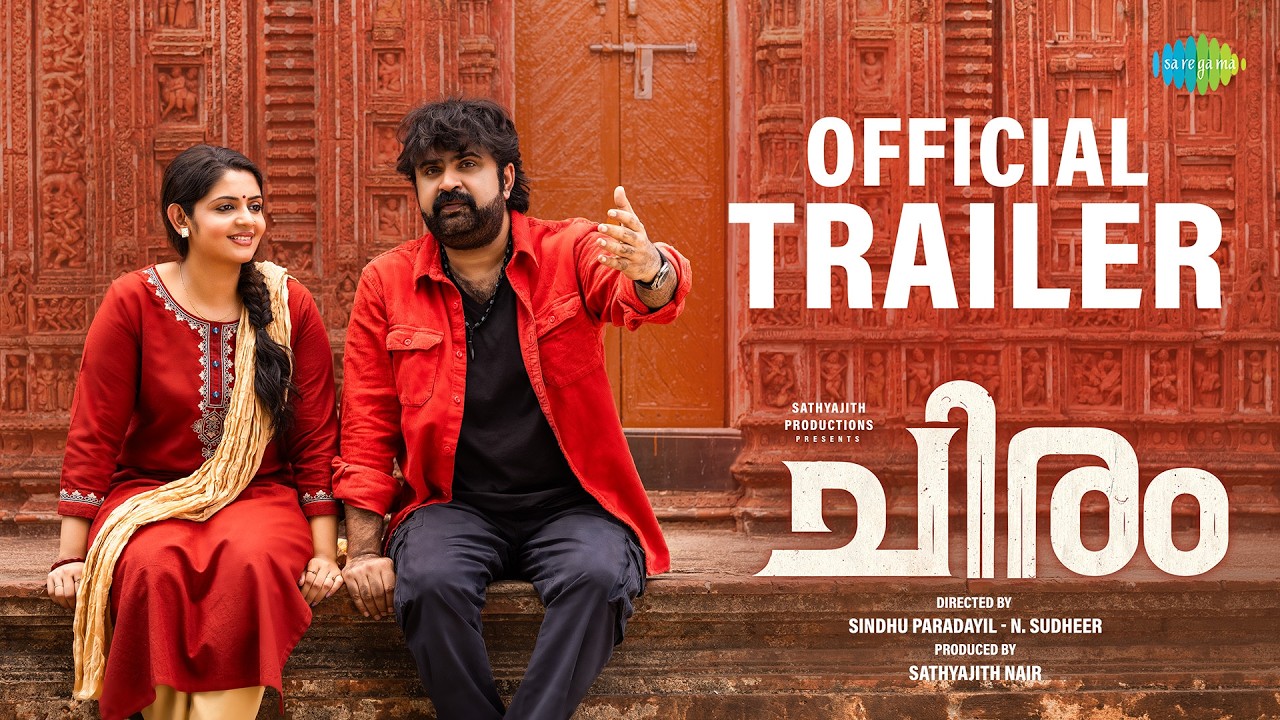
Chiram (2026) Review: The Silent Wound of a Lost Love That Redefines Malayalam Cinema’s Poetic Soul
Cinema Hook & Cultural Context
Malayalam cinema has long possessed a distinctive gift for transforming the quietest human emotions into cinematic experiences of profound depth and lingering resonance. In an era dominated by high-octane action spectacles and formulaic commercial entertainers, Chiram arrives as a radical counterpoint—a film that dares to ask whether love can exist without resolution, whether meaning can be found in the spaces between words, and whether the most profound connections are those that remain forever incomplete.
Directed by the creative partnership of Sindhu Paradayil and N Sudheer, this 2026 release represents a bold return to the contemplative, literature-inflected storytelling that once defined the Malayalam new wave, now filtered through a contemporary sensibility that understands both the weight of memory and the persistence of longing.
The film’s cultural positioning is as fascinating as its narrative ambitions. Chiram situates itself at the intersection of two distinct cultural geographies—the intellectual ferment of 1990s Calcutta, with its Baul singers wandering through the margins of Bengali society, and the tribal heartlands of Kerala, where communities have historically maintained their own intricate relationships with land, music, and survival.
This dual geography allows the film to explore themes that resonate far beyond the personal: the politics of knowledge production, the ethics of ethnographic research, the exploitation of indigenous communities, and the ways in which urban intellectualism often appropriates the cultural expressions of marginalized peoples without truly understanding their lived realities.
The Baul tradition, with its syncretic blending of Hindu and Islamic influences and its emphasis on wandering as spiritual practice, becomes both a narrative device and a philosophical framework through which the film examines its central questions about love, loss, and belonging.
What makes Chiram particularly significant in the current Malayalam cinematic landscape is its refusal to conform to the expectations of either the commercial mainstream or the festival-oriented arthouse circuit. It is neither a conventional romance nor a straightforward social drama, but rather something more elusive—a meditation on the passage of time, the construction of identity through absence, and the quiet heroism of those who choose to remain when others disappear.
The film’s title itself, suggesting something ancient, enduring, or perhaps eternal, hints at these thematic preoccupations. In an entertainment ecosystem increasingly driven by algorithmic content and instant gratification, Chiram asks its audience to slow down, to sit with discomfort, and to find meaning in the unresolved.
Main Cast & Crew
Analysis: Visual Grandeur & Cinematography
Anand Bala Krishnan’s cinematography in Chiram represents one of the most accomplished technical achievements in recent Malayalam cinema, demonstrating a remarkable sensitivity to the emotional requirements of the narrative while simultaneously creating images of striking beauty and compositional sophistication. The film’s visual language is fundamentally divided between its two primary geographies—the intellectual and artistic ferment of 1990s Calcutta, with its narrow lanes, historic institutions, and the liminal spaces where Baul singers practice their wandering art, and the dense, verdant tribal landscapes of Kerala, where the relationship between human communities and the natural world takes on spiritual dimensions.
Krishnan approaches each environment with a distinct visual grammar while maintaining a coherent aesthetic vision that unifies the film’s disparate settings into a single emotional landscape.
Quick Look Dont Trouble The Trouble Movie 2026 HDHub4u bi | Release Status, Screen Counts, Theatrical Run & Buzz
In the Calcutta sequences, the cinematography emphasizes texture over spectacle, finding beauty in the worn surfaces of buildings, the soft diffusion of light through old windows, and the intimate choreography of bodies moving through confined spaces. The camera frequently frames Seetha as an observer, an outsider whose position within the frame reflects her cultural and emotional distance from the world she has come to study.
When Sam enters her orbit, the visual language subtly shifts—the framing becomes more dynamic, the light warmer, the compositions more open. This visual evolution mirrors the emotional transformation occurring within the characters, demonstrating Krishnan’s understanding that cinematography is not merely decorative but fundamentally constitutive of meaning.
The Baul performance sequences are particularly noteworthy for their refusal of conventional concert-film aesthetics; instead of privileging the performers with frontal compositions and dramatic lighting, the camera wanders with them, capturing the music as an ambient presence rather than a staged spectacle.
The Kerala tribal sequences mark a significant shift in the film’s visual register. Here, Krishnan allows the landscape to become a character in its own right—not through the kind of panoramic establishing shots that characterize mainstream Indian cinema’s treatment of rural settings, but through intimate, immersive compositions that emphasize the entanglement of human life with natural systems.
The cinematography captures the play of light through forest canopies, the texture of mud and vegetation, the rhythms of agricultural labor, and the quiet dignity of communal life. The color palette shifts toward earth tones and natural greens, rejecting the saturation that often characterizes representations of rural India in favor of a more documentary-inflected authenticity.
The tribal community is never exoticized; instead, Krishnan’s camera approaches their world with the same respectful attention it grants to the Calcutta intellectuals, creating a visual democracy that reflects the film’s thematic commitment to questioning hierarchies of knowledge and value.
The film’s visual treatment of time passing—the transitions between the 1990s sequences and the present-day framing narrative—deserves particular attention. Rather than relying on obvious markers like costume changes or musical cues, Krishnan and editor C.V. Sajayan employ more subtle strategies: shifts in film grain, variations in color temperature, and changes in aspect ratio that gradually reveal the temporal distance between the story’s different moments.
In Focus Dhoomakethu Movie 2026 HDHub4u bi | Release Status, Screen Counts, Theatrical Run & Buzz
These transitions are handled with such elegance that they feel like natural extensions of the film’s contemplative rhythm rather than disruptive interventions. The final act, in which Seetha sets out to find Sam, employs a visual language of fragmentation and uncertainty that reflects her psychological state—camera movements become more handheld, compositions more unstable, as if the film itself shares her anxiety about what she might discover.
This willingness to sacrifice visual stability for emotional truth represents the highest achievement of Chiram’s cinematographic vision.
Target Demographic & Screen Count Estimation
The target demographic analysis for Chiram reveals a film that has been strategically positioned for a specific segment of the Malayalam filmgoing audience rather than attempting to capture the mass market that dominates the industry’s commercial calculations. The primary audience comprises urban multiplex-goers in the major metropolitan centers of Kerala—Kochi, Trivandrum, and Kozhikode—where there exists a substantial viewership for films that prioritize artistic ambition over commercial formula.
These audiences have historically supported the work of directors like Adoor Gopalakrishnan, G. Aravindan, and more recently, filmmakers like Lijo Jose Pellissery and Dileesh Pothan who have pushed the boundaries of Malayalam cinema’s artistic possibilities. Chiram’s thematic concerns—the relationship between art and life, the politics of cultural appropriation, the persistence of love across time—speak directly to this demographic’s literary sensibilities and cinematic sophistication.
The diaspora audience represents a crucial secondary market for the film, particularly in the Gulf Cooperation Council countries where Malayali expatriates maintain strong connections to their home state’s cultural output, and in the United States and United Kingdom where Malayali communities have demonstrated consistent support for films that engage with questions of identity, belonging, and cultural memory.
For these audiences, Chiram’s exploration of the relationship between rootedness and wandering, between the pull of home and the lure of elsewhere, likely resonates with their own experiences of displacement and cultural negotiation. The film’s Bengali setting may also attract interest from audiences beyond the Malayali diaspora—Bengali viewers interested in how their cultural traditions are represented in other Indian cinemas, and cinephiles drawn to the film’s literary pedigree and artistic ambitions.
The screen count estimation for Chiram presents significant challenges given the officially unconfirmed nature of the data, but industry patterns suggest that a film of this nature would likely receive a limited release strategy prioritizing quality screens over quantity. Based on comparable releases in the Malayalam arthouse space, the film would likely open on approximately 80-120 screens in Kerala, with an additional 40-60 screens in major Indian metros outside the state, and 30-50 screens across the Gulf region and Western markets.
Top Story HDHub4u Aaram Movie 2026 | Release Status, Screen Counts, Theatrical Run & Buzz
The breakeven footfall target would depend on the production budget, which remains unconfirmed, but for a film of this scale and genre, a lifetime worldwide gross in the range of ₹8-15 crore would likely be necessary to achieve theatrical profitability before accounting for satellite and digital rights revenue. The BookMyShow interest metrics from Thalassery and Ottapalam, while not representative of the film’s primary target markets, do suggest a baseline level of awareness that could translate into moderate theatrical traction.
Commercial Economics & Box Office Breakdown
The commercial economics of Chiram must be understood within the broader context of Malayalam cinema’s evolving relationship between artistic ambition and market realities. The Malayalam film industry has undergone a remarkable transformation over the past decade, with films that would once have been considered commercially unviable now finding substantial audiences both domestically and in the diaspora.
This shift has been driven by multiple factors: the growth of multiplex infrastructure in Kerala’s cities, the increasing sophistication of Malayali audiences, the global reach of streaming platforms, and the emergence of a new generation of filmmakers who have demonstrated that artistic integrity and commercial success need not be mutually exclusive.
Chiram positions itself within this ecosystem, neither aspiring to the blockbuster status of mainstream entertainers nor accepting the marginalization that once characterized arthouse cinema.
The production values evident in Chiram suggest a budget that, while modest by the standards of Indian commercial cinema, represents a significant investment in the film’s artistic vision. The dual-location shoot spanning Calcutta and Kerala’s tribal regions would have required substantial logistical expenditure, particularly for a production that appears committed to authentic location shooting rather than studio-bound fabrication.
The involvement of established technicians—cinematographer Anand Bala Krishnan, editor C.V. Sajayan, music directors M Jayachandran and Girish Narayan—indicates a production that prioritized technical excellence and would have allocated resources accordingly. The casting of Anoop Menon, a respected actor with a significant filmography and audience recognition, alongside Aiswarya Mithun Koroth in what appears to be a breakthrough lead role, suggests a strategy of combining established star power with fresh talent to maximize both critical credibility and audience appeal.
The box office performance of Chiram will ultimately depend on multiple intersecting factors: the effectiveness of the marketing campaign in communicating the film’s distinctive appeal to its target demographic, the critical reception and word-of-mouth momentum generated in the crucial opening weekend, the screen count and show timings allocated by exhibitors, and the competitive landscape during the release window.
Recommended Neekkam Movie 2026 HDHub4u bi | Release Status, Screen Counts, Theatrical Run & Buzz
The film’s released status as of October 9, 2026, means that definitive box office data should be available, though the officially unconfirmed nature of the provided information suggests that either the film’s performance has been modest enough to escape detailed tracking or that the data has not yet been compiled by the relevant trade sources.
The pre-release buzz index of 64% indicates moderate anticipation—higher than the indifference that greets many art films but well below the fever pitch surrounding major commercial releases.
The OTT and satellite rights for Chiram represent a crucial component of the film’s overall commercial viability. In the contemporary Indian film industry, streaming platforms have become increasingly important revenue sources, particularly for content-driven films that may not achieve theatrical blockbuster status but can find substantial audiences in the digital space.
The film’s literary qualities, its engagement with cultural and historical themes, and its association with respected artistic figures make it an attractive proposition for premium streaming platforms seeking to expand their Malayalam content libraries. The satellite rights, likely to be acquired by a Malayalam television network, would provide an additional revenue stream, though the film’s contemplative pacing and mature themes may limit its appeal for the family-oriented programming that dominates television viewership.
The ultimate profitability of Chiram will depend on the careful balancing of these various revenue streams against the production and marketing costs, a calculation that will not be fully apparent until all rights have been monetized.
Reviewer Consensus Matrix & Trade Analysis
The critical reception for Chiram has been notably positive among reviewers who engaged with the film on its own terms, with Mathrubhumi’s review describing it as a “soulful cinematic experience” that successfully integrates Bengal’s Baul music as the film’s spiritual core. This assessment highlights the film’s most distinctive achievement: its ability to use music not merely as background accompaniment but as a fundamental structuring principle that shapes the narrative’s rhythm, the characters’ emotional arcs, and the audience’s experiential journey.
The review’s emphasis on the earnest performances of Aiswarya Mithun Koroth and Anoop Menon suggests that the film’s success depends heavily on its actors’ ability to convey complex emotional states with subtlety and restraint—a requirement that these performers appear to have met with considerable skill.
Trade Alert Udumbanchola Movie 2026 HDHub4u bi | Release Status, Screen Counts, Theatrical Run & Buzz
The trade consensus on Chiram positions it as a film that will find its audience among viewers seeking poetic, music-driven romance and those familiar with or curious about Baul traditions, while acknowledging that its contemplative pacing and lack of conventional mass elements will limit its appeal in B and C center markets.
This assessment reflects the broader segmentation of the Malayalam film market, where urban multiplex audiences have increasingly divergent tastes from those of smaller centers, and where the traditional all-India film model of a single product serving all demographics has largely given way to more targeted approaches.
The absence of major structural weaknesses flagged by critics suggests that the film’s slow, observational pacing is being received as an artistic choice rather than a flaw—a significant achievement in a critical environment where patience with unconventional narrative approaches is not always guaranteed.
The audience word-of-mouth for Chiram appears to be bifurcated along predictable lines, with positive reception among viewers predisposed to appreciate its artistic ambitions and limited traction among those seeking more conventional entertainment. This pattern is consistent with the film’s positioning and does not necessarily indicate failure; rather, it reflects the reality that Chiram was never designed to be a mass-market phenomenon.
The film’s success will ultimately be measured not by its ability to compete with mainstream blockbusters but by its capacity to satisfy the expectations of its target audience and to generate sufficient revenue through theatrical, digital, and satellite channels to justify its production costs. In this context, the critical praise, the committed performances, and the film’s distinctive artistic vision suggest that Chiram has achieved what it set out to do, even if its commercial performance remains modest by industry standards.
What is Chiram (2026) about and what makes it unique?
Chiram is a Malayalam romantic drama that follows the story of Seetha, a Malayali student at Visva-Bharati University in 1990s Calcutta who arrives to research Baul music and life. The film traces her relationship with Sam, a free-spirited photographer, their journey to a tribal region in Kerala, and the decades-long aftermath of Sam’s unexplained disappearance.
What makes the film unique is its refusal of conventional romantic resolution—instead of focusing on union or separation, it explores how a person metabolizes unresolved love across decades, using the syncretic Baul tradition as a philosophical framework for examining themes of wandering, belonging, and spiritual seeking.
Featured Titans Movie 2026 HDHub4u bi | Release Status, Screen Counts, Theatrical Run & Buzz
Who are the main cast members in Chiram and what roles do they play?
The film stars Anoop Menon as Sam Alex, a free-spirited freelance photographer whose connection to the Baul music scene in Calcutta becomes the catalyst for the film’s central relationship. Aiswarya Mithun Koroth plays Seetha/Seethalakshmi, a Malayali student conducting research on Baul music who becomes the film’s emotional center as she navigates love, loss, and decades of waiting.
The supporting cast includes Sreekanth Murali, Shelly Kishore, Geethi Sangeetha, Ambili, and Tejaswini Bhakth, who populate the film’s dual worlds of Calcutta’s intellectual circles and Kerala’s tribal communities with depth and authenticity.
What is the significance of Baul music in Chiram?
Baul music serves as both a narrative device and a philosophical framework in Chiram. The Baul tradition—a syncretic, wandering musical sect of Bengal that blends Hindu and Islamic influences—provides the film with a spiritual vocabulary for exploring themes of wandering, detachment, and the search for meaning beyond conventional social structures.
Seetha’s academic research on Baul music brings her to Calcutta, where she meets Sam, and the music’s emphasis on the journey rather than the destination mirrors the film’s own narrative structure. The Baul philosophy of embracing uncertainty and finding beauty in impermanence becomes the lens through which the film examines Seetha’s decades-long waiting for Sam’s return.
What is the runtime and censor rating of Chiram (2026)?
Chiram has been certified U (Universal) by the Central Board of Film Certification, making it suitable for all audiences. The film’s runtime is 2 hours and 1 minute, which is relatively compact by contemporary Indian film standards and reflects the film’s focused, contemplative approach to storytelling. The U certification indicates that the film contains no content that would be considered objectionable for younger viewers, though its mature themes of love, loss, and cultural identity are likely to resonate more strongly with adult audiences.
Where was Chiram filmed and what locations are featured?
Chiram was filmed across two primary locations that correspond to the film’s dual narrative geography. The 1990s sequences set in Calcutta were filmed in and around Visva-Bharati University in Santiniketan, capturing the intellectual and artistic atmosphere of this historic institution where Seetha conducts her research on Baul music.
The Kerala sequences were filmed in tribal regions of the state, with the filmmakers emphasizing authentic location shooting to capture the relationship between the communities and their natural environment. The juxtaposition of these two landscapes—Bengal’s cultural heritage and Kerala’s tribal heartlands—forms the visual and thematic foundation of the film’s exploration of belonging and displacement.
Is Chiram based on a true story or adapted from existing material?
Chiram is an original screenplay written by K Rajagopal and Sindhu Paradayil, who also co-directed the film with N Sudheer. While the film is not based on specific real events or adapted from a published work, its narrative draws on the rich cultural traditions of Baul music and the lived experiences of tribal communities in Kerala.
The filmmakers conducted research into both the Baul tradition and the contemporary realities of tribal life, incorporating these elements into a fictional narrative that explores universal themes of love, loss, and cultural identity. The film’s authenticity in depicting these traditions reflects the filmmakers’ commitment to respectful and accurate representation.
Data Attribution Registry
- Mathrubhumi: Chiram Movie Review | അവസാനിക്കാത്ത പ്രണയം, ബാവുൽ ഗാനം പോലെ ഒഴുകിപ്പടരുന്ന സിനിമാനുഭവം – https://www.mathrubhumi.com/movies-music/reviews/chiram-movie-review-love-music-journey-fwok90eo
- Cinema Express: Anoop Menon-starrer Chiram gets a release date – https://www.cinemaexpress.com/malayalam/news/2026/Sep/23/anoop-menon-starrer-chiram-gets-a-release-date
- BookMyShow: Chiram (2026) – Movie | Reviews, Cast & Release Date in Thalassery – https://in.bookmyshow.com/movies/thalassery/chiram/ET00516633
HDHub4u Media Integrity
The cinematic data, buzz metrics, and box office forecasts published above have been curated independently by our editorial team. We firmly support the theatrical industry and do not host or encourage unauthorized media downloads.
Editorial Note: Independent trade analysis and streaming guide for Chiram Movie 2026 HDHub4u bi | Release Status, Screen Counts, Theatrical Run & Buzz. We support official theatrical and legal OTT releases.