Bhogi (2026) Telugu Movie: Sharwanand’s Blood-Soaked Transformation, Sampath Nandi’s Period Gamble & The Brutal Economics of Pan-India Rustic Action
Cinema Hook & Cultural Context
There is a peculiar hunger in Telugu cinema right now—a craving for the soil, the sweat, and the blood of the hinterland. The phenomenal success of Pushpa, the raw intensity of Kantara, and the operatic brutality of Dasara have collectively proven that audiences across India are willing to pay premium prices to watch stories rooted in rural oppression, feudal vengeance, and the violent emancipation of the downtrodden.
Into this crowded but commercially fertile arena steps Bhogi, a period action drama that marks one of the most dramatic image reinventions attempted by a mainstream Telugu star in recent memory. Sharwanand, the actor who built a career on urban romantic comedies and soft-spoken middle-class protagonists in films like Shatamanam Bhavati and Padi Padi Leche Manasu, has entirely abandoned his charming-boy persona to embody Kammari Ganga, a blacksmith whose hammer is less an instrument of craft and more a metaphor for the revolutionary violence simmering beneath the surface of an oppressive society.
The film arrives at a critical inflection point for Telugu cinema’s relationship with the pan-India market. After a string of expensive, star-driven period spectacles that either underperformed or outright bombed—victims of their own narrative familiarity and escalating budgets—the industry is grappling with an existential question: has the audience finally tired of the mass period-action template?
Trade commentators have been openly debating whether the genre that defined the post-pandemic theatrical resurgence has now reached saturation, with every new announcement of a rustic revenge saga met with a mixture of anticipation and weary skepticism. Bhogi, positioned for a November 12, 2026 release during the lucrative pre-Diwali festive window, will serve as a crucial test case for whether star transformation and technical accomplishment can overcome template fatigue—or whether it will become another casualty of an increasingly risk-averse audience.
What makes Bhogi particularly intriguing is its specificity of setting. Rather than opting for the vague “rural India” aesthetic that plagues many pan-India productions, the film plants itself firmly in the early 1960s along the volatile Telangana-Maharashtra border—a region whose cultural identity is a complex weave of Telugu and Marathi traditions, whose history is scarred by the Nizam’s exploitation and the subsequent peasant uprisings, and whose dialect carries the grit of a people who have historically been both geographically and politically marginalized.
The title itself is laden with symbolism: Bhogi is the first day of the four-day Sankranti harvest festival, marked by the Bhogi bonfire—a ritual burning of old possessions to herald renewal. That the film positions its narrative of violent revolt against this framework of purgative destruction suggests an ambition that extends beyond mere revenge thriller territory into the realm of mythological allegory.
Main Cast & Crew
Analysis: Visual Grandeur & Cinematography
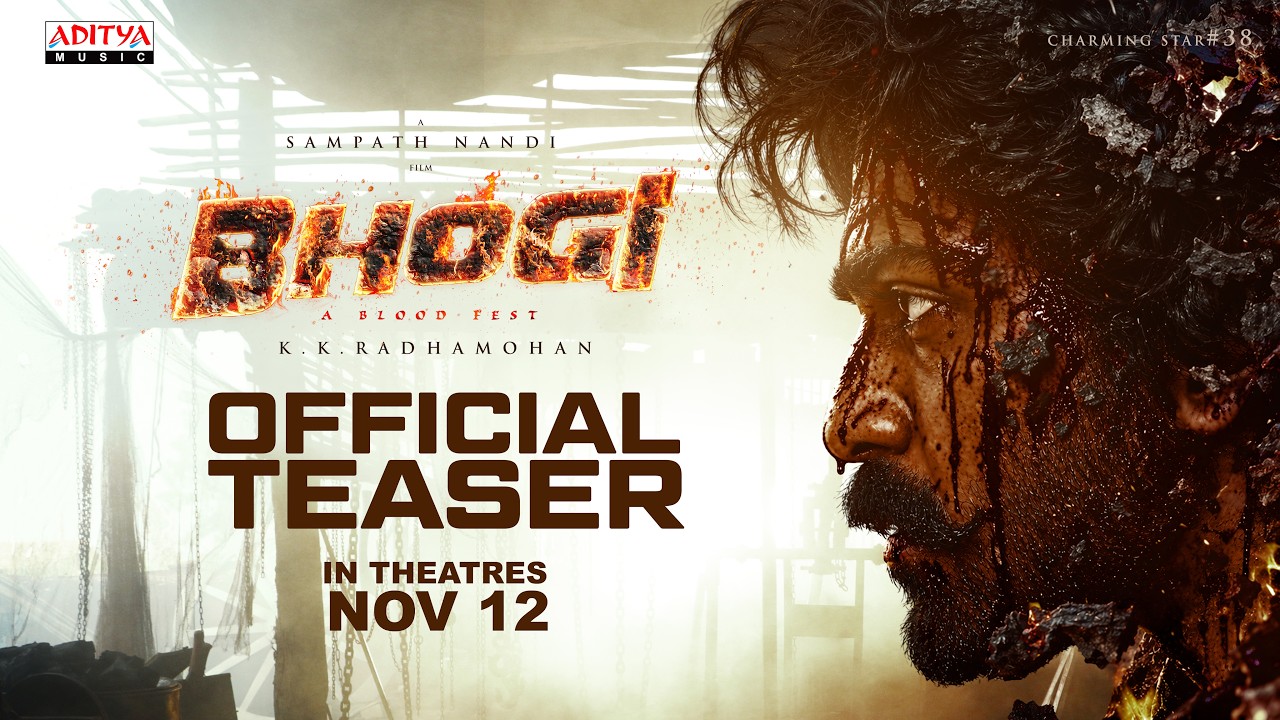
The teaser of Bhogi immediately announces its visual intentions with an unflinching commitment to tactile authenticity. Cinematographer Kishor Kumar has constructed a visual grammar that eschews the glossy, color-graded sheen that typically characterizes big-budget Telugu productions in favor of a grainy, almost documentary-like texture that feels culled from archival footage of rural India in the 1960s.
The color palette is dominated by earthy browns, muted ochres, and the deep blacks of shadow and soot—the blacksmith’s forge providing not just a narrative occupation for the protagonist but a visual centerpiece around which the film’s chiaroscuro aesthetic is built. The interplay of firelight against darkness, the sparks flying off hammered iron, the sweat glistening on weathered faces—these are images designed not merely to look impressive but to embed the viewer in a physical world that feels dangerously real.
Production designer Kiran Kumar Manne’s contributions are equally significant in establishing the film’s period credibility. The village set, constructed to evoke the Telangana-Maharashtra border region of the early 1960s, is a meticulously detailed recreation that avoids the museum-piece stiffness that afflicts lesser period productions.
Quick Look Ranabaali Movie 2026 HDHub4u bi | Release Status, Screen Counts, Theatrical Run & Buzz
The thatched roofs sag with the weight of years; the mud walls bear the stains of smoke and monsoon; the tools of the blacksmith’s trade—anvils, bellows, hammers of varying sizes—appear genuinely worn through decades of use. Manne’s design extends to the costumes, which reflect the specific sartorial traditions of the region and era: the women in traditional Telangana-style saris with distinctive border patterns, the men in dhotis and kurtas that speak to both agricultural labor and craftsman identity, the feudal lord’s enforcers in a distinct visual register of authority and menace.
This attention to material detail creates a world that feels inhabited rather than merely assembled.
The action choreography by Dilip Subbarayan, judging from the teaser’s brief glimpses, appears to follow the school of grounded, brutal physicality that has become the hallmark of the new wave of rural action cinema. There are no wire-assisted acrobatics or stylized martial arts sequences here; instead, the combat is visceral, clumsy in its realism, and horrifying in its intimacy.
The blacksmith’s hammer, the agricultural sickle, the bare fist—these are weapons of necessity rather than spectacle, and Subbarayan’s choreography seems designed to emphasize the desperation and rage underlying each blow. The teaser’s climactic moments suggest a mass action sequence involving the village community rising against their oppressors, the visual composition echoing both historical peasant revolts and the mythic imagery of divine retribution.
However, the most striking visual element—and the one that has generated the most discussion among trade analysts—is Sharwanand’s physical transformation. The actor has shed his characteristic boyishness entirely, appearing gaunt, sun-darkened, and hardened in ways that go beyond mere weight loss. His body language in the teaser speaks to a man for whom physical labor is not a noble calling but a daily grind, whose hands are calloused and whose posture carries the permanent slight stoop of the blacksmith bent over his anvil.
This is a performance of physicality as much as dialogue, and the visual evidence suggests Sharwanand has committed to the role with an intensity that may prove career-defining—or career-endangering, depending on whether audiences accept him in this radically different avatar.
Target Demographic & Screen Count Estimation
The demographic calculus for Bhogi reveals both opportunity and significant risk. The film’s natural constituency lies in the mass single-screen centers of Telangana and Andhra Pradesh, where rural action dramas with strong underlying social themes have historically found their most passionate audiences. These are the theaters where Pushpa: The Rise initially built its legendary word-of-mouth before expanding to national phenomenon status; these are the audiences who understand the specific cultural codes of the Telangana-Maharashtra border region, who recognize the authenticity in the dialect, the rituals, the social hierarchies depicted.
For these viewers, the film does not require the mediation of “universal appeal”—it simply needs to be genuine, to respect the world it depicts, and to deliver the cathartic violence that the narrative promises. Sampath Nandi’s challenge is to ensure that Bhogi speaks authentically to this core audience while remaining accessible enough to cross over to the multiplex crowd.
In Focus Jailer 2 Movie 2026 HDHub4u bi | Release Status, Screen Counts, Theatrical Run & Buzz
The multiplex demographic presents a more complicated proposition. Urban, educated, English-speaking audiences—the ones who drive social media discourse and whose opinion shapes the “buzz” that trade analysts track—have demonstrated a growing impatience with what they perceive as formulaic storytelling. They will show up for a period rural drama if it offers something genuinely distinctive, as they did for Kantara‘s mythological dimensions or RRR‘s spectacular maximalism.
But they will ruthlessly dismiss a film that feels like a retread of familiar beats, and their social media verdict can kill a film’s chances of building sustained word-of-mouth. The commentary from outlets like M9.news—which explicitly argued that “Peddi, Paradise, Bhogi: Mass Formula Tiring Out Audiences”—represents this constituency’s skepticism.
For Bhogi to succeed beyond its core base, it must offer these audiences a reason to care that goes beyond Sharwanand’s physical transformation or the technical polish of its production values.
The screen count trajectory for a film like Bhogi typically follows one of two paths. If advance bookings and early reviews are strong, the film can secure 1,000+ screens across India with a simultaneous pan-India release in Hindi, Tamil, Kannada, and Malayalam—maximizing the opening weekend before word-of-mouth crystallizes.
If early indicators are soft, distributors may opt for a phased release, opening in Telugu states first and expanding only if the film demonstrates the “hold” (sustained occupancy over multiple weeks) that signals genuine audience approval. Given the current uncertainty around the film’s commercial prospects, a conservative estimate might see 800-1,000 screens in the Telugu states alone, with 200-400 additional screens across other territories if the pan-India push materializes.
The breakeven footfall, calculated against an undisclosed budget that trade estimates place anywhere between Rs 40-60 crores (including print and advertising), would require approximately 4-5 million admissions across all territories—a target that is achievable but by no means guaranteed in the current market environment.
Commercial Economics & Box Office Breakdown
The commercial mathematics of Bhogi operate within a framework of considerable uncertainty, reflecting both the film’s undisclosed budget and the volatile state of the theatrical market for period action dramas. What is clear is that the film occupies a challenging middle ground in the current Telugu cinema ecosystem: it is too expensive to be a modest, low-risk venture but not expensive enough to command the kind of automatic opening weekend that mega-budget star vehicles enjoy.
This “middle-class” positioning—both in terms of budget and target audience—places enormous pressure on the film’s quality and word-of-mouth to generate the sustained occupancy that translates into profitability. Unlike a Pushpa 2 or an RRR, which can absorb mixed reviews through sheer scale of opening, Bhogi needs positive audience reception from day one to build the momentum that will carry it through its theatrical run.
Top Story Mayookha Movie 2026 HDHub4u bi | Release Status, Screen Counts, Theatrical Run & Buzz
The revenue streams for a film of this scale follow a predictable but precarious pattern. Theatrical collections in the Telugu states will constitute the largest share of revenue, typically accounting for 60-70% of the total. The overseas market—particularly North America, where Telugu diaspora audiences have demonstrated strong support for well-received films—can contribute another 15-20%, though this depends heavily on the film’s appeal to the NRI demographic, which tends to skew toward more urban, contemporary stories.
The pan-India Hindi market represents the wild card: if Bhogi connects with Hindi-belt audiences the way Kantara did, the upside could be transformative, potentially doubling the film’s total revenue. But if the Hindi version fails to find traction—a common outcome for Telugu films that lack either a major pan-India star or a genuinely distinctive hook—it becomes an expensive afterthought rather than a meaningful revenue contributor.
The ancillary revenue streams—satellite rights, digital streaming rights, audio rights—have become increasingly important for mid-budget films seeking to minimize theatrical risk. A strong OTT deal can cover 30-40% of a film’s budget before a single ticket is sold, providing a financial cushion that allows distributors to take greater risks on the theatrical release.
The absence of announced streaming partner information for Bhogi at this stage is notable: it suggests either that negotiations are still ongoing (possibly a sign of leverage on the producer’s part, betting on the film’s theatrical success to drive up the digital price) or that the film is being positioned as a pure theatrical play with a post-release OTT deal.
The first single, “Egili Varanga,” has performed respectably on streaming platforms, suggesting that the film’s music—composed by Bheems Ceciroleo with lyrics by Chandrabose—could provide a meaningful additional revenue stream if other tracks from the album generate similar traction.
The breakeven analysis ultimately hinges on variables that remain stubbornly opaque. If the production budget is indeed in the Rs 35-50 crore range, the film would need to gross approximately Rs 70-100 crores worldwide to reach profitability after accounting for distributor margins, theater shares, and the various government levies that consume a significant portion of box office revenue.
For a mid-tier Telugu star vehicle with strong regional appeal but uncertain pan-India prospects, this is a challenging but not impossible target. Much depends on whether Bhogi can achieve the kind of long-tail theatrical run—sustained occupancy over 4-6 weeks rather than a front-loaded opening weekend collapse—that distinguishes genuinely successful films from expensive disappointments in the current market.
Today’s Reviewers Pulse: Critic & Trade Consensus Matrix
The critical reception to Bhogi‘s teaser and first single has been notably bifurcated, revealing a trade and reviewer community deeply divided not just on the film’s quality but on the broader question of whether the period rural action drama has exhausted its creative and commercial potential. The positive assessments cluster around three key areas: Sharwanand’s transformation, the technical excellence of the production, and the authenticity of the folk-infused musical and visual language.
Recommended Comrade Kalyan Movie 2026 HDHub4u bi | Release Status, Screen Counts, Theatrical Run & Buzz
Critics who have followed Sharwanand’s career from his early romantic comedies have expressed genuine surprise at the physical and performative commitment evident in the teaser, with several noting that his lean, hardened appearance and mastery of Telangana dialect represent a genuine reinvention rather than a superficial makeover.
Cinema Express, in its coverage of the film’s action sequences, highlighted the actor’s dedication to physical preparation and the intensity of the stunt choreography by Dilip Subbarayan.
Bheems Ceciroleo’s background score and Chandrabose’s lyrics for “Egili Varanga” have received particular praise for their emotional resonance and cultural specificity. Telugu360, in its analysis of the song, described it as “the soul of Bhogi”—a piece of music that does not merely accompany the visuals but actively constructs the emotional and cultural world of the film.
The choice to employ folk vocalists like Nalgonda Gaddar Narasanna, Relare Gopal, Narsireddy, and Kandukuri Shankar Babu rather than playback singers with more commercial profiles signals a deliberate artistic choice to prioritize authenticity over marketability—a decision that has earned the filmmakers respect from critics who value cultural fidelity but may limit the song’s appeal on mainstream music charts.
The visual presentation of the song, capturing the rhythms of 1960s Telangana village life, has been singled out for its beauty and period accuracy.
However, the critical consensus is far from uniformly positive, and the dissenting voices raise concerns that go to the heart of the film’s commercial viability. Ragalahari’s assessment—that Bhogi “risks being perceived as derivative of Dasara and Kantara”—articulates a concern that has been simmering in trade circles for months.
The comparison to Dasara is particularly pointed: both films feature a rustic setting, a protagonist from a marginalized community who rises against feudal oppression, a violent climactic confrontation, and a visual aesthetic rooted in the textures of rural South India. Kantara comparisons arise from the film’s engagement with folk traditions, its integration of cultural rituals into the narrative fabric, and its portrayal of a community’s collective struggle against external oppression.
The question that Ragalahari and others are asking is whether Bhogi offers anything genuinely new within this framework, or whether it is merely a competent but unoriginal entry in an increasingly crowded genre. The suggestion that the film “needs a significant twist to distinguish itself” is both a critical observation and a commercial warning: in a market where audiences are spoiled for choice, sameness is a death sentence.
Trade Alert Rupayanamaha Movie 2026 HDHub4u bi | Release Status, Screen Counts, Theatrical Run & Buzz
The most pointed critique comes from M9.news, whose article “Peddi, Paradise, Bhogi: Mass Formula Tiring Out Audiences” argues that Telugu cinema’s over-reliance on oppressed-community narratives, brutal villains, and blood-soaked hero elevations has begun to alienate viewers seeking variety. This critique touches on a genuine tension in the current market: the same formula that produced hits like Pushpa and Kantara has now been replicated so many times that it risks becoming self-parody.
Audiences who have seen the same basic story—the humble man pushed too far who becomes a violent avenger—repeated across a dozen films may find themselves unable to muster enthusiasm for yet another iteration, no matter how well-executed. The M9.news critique suggests that Bhogi is arriving at precisely the wrong moment in the cycle, when audience fatigue has set in and the genre’s commercial ceiling has been lowered by overexposure.
The consensus that emerges from this divided critical landscape is that Bhogi is technically accomplished, features a committed lead performance, and demonstrates genuine craft in its production design, cinematography, and music. But its commercial prospects hinge entirely on whether the full film offers narrative novelty within the familiar period-action framework.
If Sampath Nandi has found a genuinely fresh angle on the material—a twist that recontextualizes the familiar beats, a character dynamic that adds emotional complexity, a thematic depth that transcends the revenge thriller template—then Bhogi could overcome the skepticism and emerge as a significant success. If, however, the film unfolds exactly as the teaser suggests—a faithful but uninspired execution of a well-worn formula—it risks being lost in the shuffle, another would-be Pushpa that never found its own identity.
Frequently Asked Questions
What is the release date of Bhogi (2026)?
Bhogi is scheduled for theatrical release on November 12, 2026, positioning it in the lucrative pre-Diwali festive window. The film is planned as a pan-India release across Telugu, Hindi, Tamil, Kannada, and Malayalam languages, though the exact number of screens and territories remains officially unconfirmed at this stage of production.
Who plays the lead role in Bhogi and what is his character?
Sharwanand stars as Kammari Ganga, a blacksmith living in a fictional village along the Telangana-Maharashtra border in the early 1960s. The character represents the dignity of skilled labor and the quiet resilience of the working class, who is pushed into rebellion against the brutal feudal system that oppresses his community.
This role marks a radical departure from Sharwanand’s established persona as a charming romantic lead.
What is the story premise of Bhogi?
Bhogi transports audiences to the early 1960s in a village along the volatile Telangana-Maharashtra border, where a blacksmith named Ganga confronts the brutal feudal system that treats farmers and laborers as virtual slaves. When circumstances force him into direct confrontation with the oppressive power structure, the narrative pivots from a portrait of endurance to a chronicle of violent revolt.
Featured Samavarthi Movie 2026 HDHub4u bi | Release Status, Screen Counts, Theatrical Run & Buzz
The title references the Bhogi bonfire ritual of the Sankranti harvest festival, symbolizing the burning away of the old order to make way for a more just society.
Who are the actresses in Bhogi and what roles do they play?
Anupama Parameswaran plays Kandula Sulochana Rani, described as the emotional anchor of Ganga’s world—an innocent, hardworking village belle whose presence grounds the protagonist in a vision of a life worth fighting for. Dimple Hayathi plays Mandaram, a secondary character who potentially represents another facet of village womanhood caught in the crossfire of feudal brutality.
Both characters’ arcs intersect with Ganga’s journey, raising the stakes from personal survival to communal liberation.
What is the technical team behind Bhogi?
Bhogi is directed by Sampath Nandi, with music composed by Bheems Ceciroleo and lyrics by Chandrabose. The cinematography is by Kishor Kumar, action choreography by Dilip Subbarayan, and production design by Kiran Kumar Manne. The film is produced by KK Radhamohan under the Sri Sathya Sai Arts banner, with Lakshmi Radhamohan serving as presenter.
The first single, “Egili Varanga,” was released in October 2026.
Why is Bhogi compared to Dasara and Kantara?
Critical commentary has noted that Bhogi shares significant thematic and aesthetic similarities with Dasara and Kantara—including a rustic rural setting, a protagonist from a marginalized community who rises against feudal oppression, a violent climactic confrontation, and a visual aesthetic rooted in the textures of rural South India.
The concern raised by reviewers like Ragalahari is that Bhogi needs a significant narrative twist to distinguish itself from these earlier films and avoid being perceived as derivative. The film’s commercial prospects may depend on whether it offers genuine novelty within this familiar framework.
Data Attribution Registry
- Cinema Express: Sharwanand and Sampath Nandi’s Bhogi goes into action mode – https://www.cinemaexpress.com/telugu/news/2026/Jun/12/sharwanand-and-sampath-nandis-bhogi-goes-into-action-mode
- Telugu360: Egili Varanga: The Soul of Bhogi – https://www.telugu360.com/egili-varanga-the-soul-of-bhogi/
- Ragalahari: Bhogi: Familiar Period Actioner Needs a Twist to Rise Above Dasara, Kantara Comparisons – http://ragalahari.site/tollywood-news-2026-october/178029/bhogi-familiar-period-actioner-needs-a-twist-to-rise-above-dasara-kantara-comparisons
HDHub4u Media Integrity
The cinematic data, buzz metrics, and box office forecasts published above have been curated independently by our editorial team. We firmly support the theatrical industry and do not host or encourage unauthorized media downloads.
Compliance Statement: This article is an informational review of Bhogi Movie 2026 HDHub4u bi | Release Status, Screen Counts, Theatrical Run & Buzz and does not host or link to unauthorized media files.