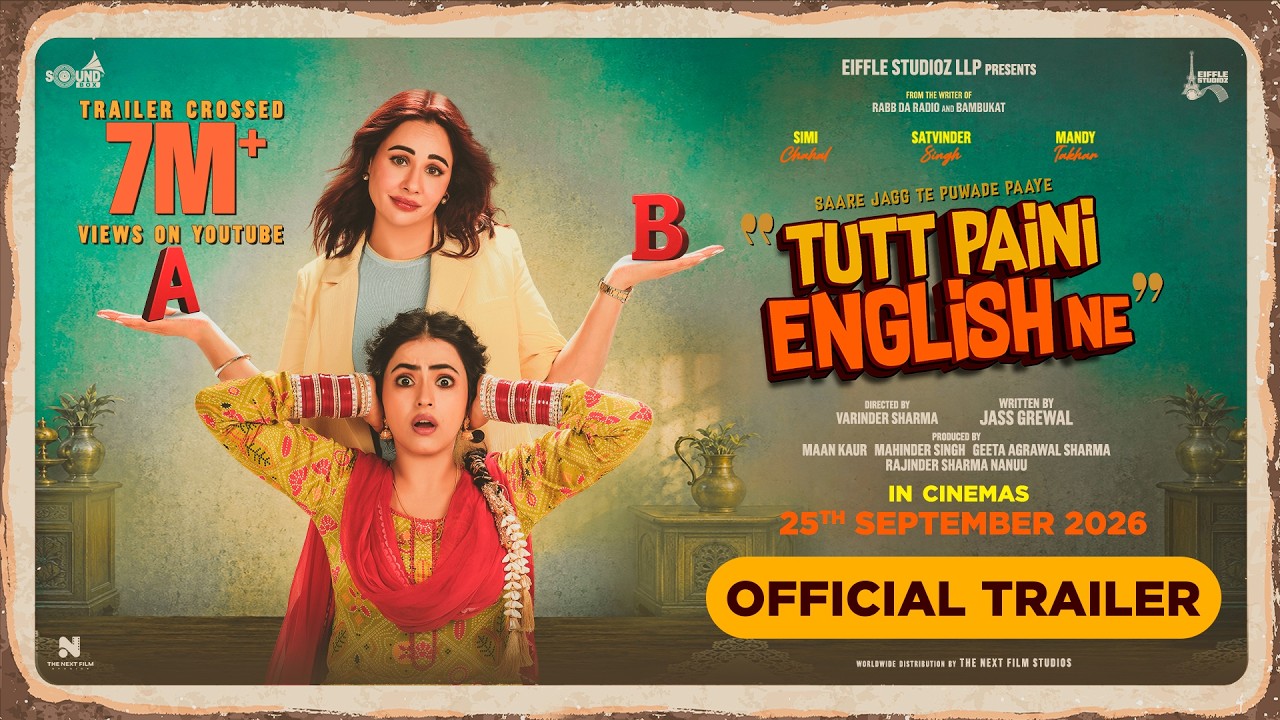

Tutt Paini English Ne (2026) Box Office Prediction: Will Simi Chahal & Mandy Takhar’s Language Comedy Break Punjabi Cinema Records?
Deep Cinema Hook & Cultural Significance: The Punjabi Village That Weaponised English
There is a particular kind of anxiety that grips the modern Punjabi household, and it has very little to do with money, land, or politics.
It has everything to do with a single, devastating question that matriarchs across the diaspora and the homeland ask with equal ferocity: “Ki ohdi English aundi hai?” Does she speak English?
This question, deceptively simple in construction, carries the weight of generations of colonial residue, migration aspiration, and the relentless pressure of social comparison that defines large swathes of Punjabi society.
Tutt Paini English Ne, slated for a 25 September 2026 theatrical arrival, takes this precise cultural nerve and pinches it hard, extracting comedy, pathos, and a deeply uncomfortable mirror in the process.
The film arrives at a fascinating inflection point for Punjabi cinema. The industry has spent the better part of the last decade oscillating between two extremes—either loud, slapstick-heavy comedies that prioritise gags over narrative coherence, or sweeping romantic dramas set against mustard fields with little interest in contemporary social reality.
What Tutt Paini English Ne attempts is something considerably more sophisticated, though packaged in the accessible wrapper of a family entertainer.
It sits squarely in the tradition of socially observant Punjabi comedy, a lineage that stretches back through the works of writers who understood that the funniest moments in a Punjabi village are never manufactured; they emerge organically from the collision between tradition and modernity, between what people are and what they desperately wish to appear as.
The cultural significance of this film extends well beyond its immediate entertainment value. Language, in the Punjabi context, has never been a neutral tool of communication.
It is a marker of class, a badge of migration-readiness, and increasingly, a source of generational tension.
Grandparents who speak pristine Punjabi watch their grandchildren struggle to form complete sentences in the mother tongue.
Parents who sacrificed everything to send children abroad now find themselves unable to communicate with those very children.
And somewhere in the middle of this linguistic chasm, a woman named Gagan decides that faking English fluency is the only way to secure her place in a family that values the language more than it values her.
The film, in choosing this premise, is not merely making a comedy. It is holding up a mirror to a community’s collective neurosis, and the reflection, however hilarious, is also quietly devastating.
What makes the timing particularly compelling is the ongoing discourse around the Punjabi language’s diminishing status in urban households and its perceived “uncoolness” among younger demographics.
Tutt Paini English Ne enters this conversation armed with humour rather than lectures, making its point through the escalating chaos of a lie that grows beyond its creator’s control.
The village setting is crucial here—it provides the intimacy of a pressure cooker where reputation is communal property and every misstep is observed, discussed, and amplified.
In a city, Gagan’s deception might go unnoticed. In a Punjabi village, it becomes the day’s primary entertainment.
The film understands this dynamic instinctively, and the trailer’s glimpses of community reactions suggest that the ensemble cast will have ample opportunity to shine as unwitting participants in Gagan’s elaborate performance.
Main Cast & Crew: The Collaborative Architecture Behind the Laughter
The casting of Simi Chahal as Gagan represents a particularly shrewd piece of assembly. Chahal has, over the course of her career, demonstrated an ability to inhabit characters who are simultaneously vulnerable and resilient—women who find themselves in impossible situations and navigate them with a combination of ingenuity and sheer stubbornness.
Gagan requires exactly this register. She is not a con artist by nature; she is a young woman who has been placed in an impossible position by societal expectations and has chosen the path of least immediate resistance, only to discover that the path has no exit.
Chahal’s comedic timing, visible in flashes throughout her filmography, will be tested here in ways it hasn’t been before.
The role demands physical comedy, verbal dexterity, and emotional sincerity in nearly equal measure, often within the same scene.
The reunion of Chahal with Mandy Takhar is the film’s most potent marketing weapon, and the trade has already seized upon it.
Their previous collaboration in the Rabb Da Radio series established a chemistry that transcended the screen, a dynamic of mutual respect and unspoken understanding that audiences responded to warmly.
Quick Look Eh Din Roz Ni Aune Movie 2026 HDHub4u bi | Release Status, Screen Counts, Theatrical Run & Buzz
While Takhar’s role in Tutt Paini English Ne remains officially unconfirmed in terms of specific character details, her presence alone signals an expansion of the film’s emotional palette.
Takhar brings a gravitas to her performances that balances Chahal’s more effervescent energy, and if the narrative positions their characters in any kind of contrasting dynamic—perhaps one who genuinely possesses the sophistication Gagan pretends to have—the dramatic tension could elevate the film beyond its comedic foundation.
The supporting cast reads like a roll call of Punjabi cinema’s most reliable character actors. Rupinder Rupi, as the status-obsessed matriarch Rupinder Kaur, has the kind of face that can convey judgment, disappointment, and barely concealed social anxiety without a single line of dialogue.
She is the engine of the film’s central conflict, the woman whose demand for an English-speaking daughter-in-law sets everything in motion.
Gurpreet Bhangu, a veteran whose career spans decades of Punjabi theatre and cinema, brings institutional memory to the production.
Kulwinder Kaur and Evelyn Dhillon round out the ensemble, while Satvinder Singh’s “Special Role” suggests a narrative function that the marketing has chosen to keep under wraps.
The presence of Varinder Sharma in the director’s chair, working from a Jass Grewal screenplay, indicates a production that prioritises writing and performance over spectacle—a wise choice for a film whose entire premise rests on the credibility of its central deception.
Deep Analysis: Visual Grandeur, Rural Authenticity & The Cinematography of Social Performance
Punjabi cinema has, in recent years, developed something of a visual inferiority complex. Productions have increasingly sought to mimic the sheen of Bollywood or the prestige aesthetic of streaming content, often at the cost of the grounded, textured visual language that once defined the industry’s best work.
The early promotional material for Tutt Paini English Ne suggests a deliberate rejection of this trend.
The film appears to have been shot with an eye toward authenticity—the village is not a sanitised, colour-graded fantasy of rural life but a living, breathing space with the specific textures of actual Punjabi settlements.
The architecture, the clothing, the way light falls through the windows of a traditional home—these are details that matter in a film whose entire thematic foundation rests on the tension between authenticity and performance.
The 2.39:1 Scope aspect ratio is an interesting choice for a film of this nature. Scope is traditionally associated with spectacle—wide vistas, sweeping landscapes, the visual language of epics.
Applying it to a family comedy set in a village could be read as an assertion that small stories deserve the same visual grandeur as large ones.
The wide frame allows for the kind of group compositions that are essential to a film about communal observation and social performance, where the reaction of the collective is as important as the action of the individual.
When Gagan commits one of her linguistic blunders, the Scope frame can contain not just her discomfort but the ripple effect across the room—the raised eyebrows, the exchanged glances, the barely suppressed smiles.
This is cinema that understands the comedic potential of spatial relationships.
While the specific Director of Photography and production designer remain officially unconfirmed, the visual approach evident in the trailer indicates a preference for natural lighting and practical locations.
The village is shot with a warmth that suggests genuine affection for the setting, even as the narrative critiques its social dynamics.
This is a delicate balance—the film must simultaneously expose the absurdity of linguistic snobbery while celebrating the community that perpetuates it.
The visual language supports this duality by presenting the village as a place of beauty and belonging, even as the dialogue and situations reveal its more problematic aspects.
The colour palette appears to favour earthy tones, warm ochres, and the specific greens of Punjab’s agricultural landscape, creating a visual world that feels lived-in rather than designed.
The film’s 106-minute runtime is worth noting in the context of the comedy genre. Contemporary comedies, particularly those produced for theatrical release, often struggle with pacing, extending themselves beyond their natural conclusions in an attempt to deliver “value” through sheer duration.
A 106-minute runtime suggests a disciplined approach to storytelling, a willingness to tell the story that needs to be told and then step aside.
In Focus Paper Tiger Movie 2026 HDHub4u bi | Release Status, Screen Counts, Theatrical Run & Buzz
This is particularly important for a film whose central tension—the maintenance of a lie—has a natural expiration point.
The comedy of escalation works best when it builds steadily toward a breaking point, and the runtime suggests the film has the confidence to reach that point without unnecessary detours.
The production design, while not explicitly detailed in available materials, must grapple with a specific challenge: creating a visual distinction between the “traditional” spaces of the village home and the aspirational spaces where English is performed.
The way rooms are dressed, the objects that populate them, the arrangement of furniture that either facilitates or frustrates communal observation—these are the invisible architects of the film’s comedy.
Similarly, the costume design must navigate the subtle codes of Punjabi rural fashion, where a particular style of dupatta or the presence of certain jewellery can communicate volumes about a family’s economic status and social pretensions.
In a film about the performance of status, every visible element of production design becomes a piece of that performance, for both the characters and the filmmakers.
Target Demographic, Screen Count Estimation & Theatrical Breakeven Analysis
The target demographic analysis for Tutt Paini English Ne reveals a film that is positioning itself for maximum penetration across the Punjabi-speaking world.
The primary audience—families in Punjab and the mass single-screen centres of smaller towns—represents the traditional core of Punjabi cinema’s theatrical business.
These are viewers who have grown up with the industry, who understand its rhythms and references, and who are most likely to respond to a film that treats their lived reality with both humour and respect.
The decision to set the film in a traditional Punjabi village is not merely aesthetic; it is a calculated appeal to the audience that has historically been the backbone of the industry’s commercial performance.
The youth demographic represents a more complex proposition. Younger Punjabi viewers, particularly those in urban centres, have increasingly gravitated toward Hindi cinema or international streaming content, finding Punjabi films either too rural in their sensibility or too derivative in their attempts to appear modern.
Tutt Paini English Ne has the potential to bridge this gap by addressing a theme that resonates specifically with younger audiences—the anxiety of linguistic performance, the pressure to code-switch, and the feeling of being caught between two cultural expectations.
For a young professional in Chandigarh who speaks Punjabi at home and English at work, Gagan’s predicament is not merely comedic; it is recognisable.
The film’s success in attracting this demographic will depend heavily on its marketing, which has so far emphasised the comedic elements while hinting at the emotional depth beneath.
The diaspora audience is, in many ways, the most crucial component of the film’s commercial strategy.
Overseas Punjabi audiences have consistently demonstrated a willingness to support theatrical releases that speak to their cultural experience, and the theme of language anxiety is particularly potent in diaspora communities where the maintenance of Punjabi identity is an ongoing negotiation.
The film’s setting—a Punjabi village—also serves as a nostalgic touchstone for diaspora viewers, offering a vision of home that is simultaneously familiar and distant.
The estimated 150-200 overseas screens across Canada, Australia, New Zealand, the UK, and the USA represent a significant revenue stream, particularly given the higher ticket prices in these markets.
The estimated total screen count of 500-650 worldwide is ambitious but not unreasonable for a well-marketed Punjabi family entertainer with recognisable stars and a relatable premise.
The theatrical breakeven footfall of approximately 8-10 lakh admissions across all territories reflects the typical economics of mid-budget Punjabi cinema, where production costs are relatively modest compared to Hindi film standards but marketing and distribution expenses still require significant audience turnout.
The film’s ability to achieve these numbers will depend on multiple factors: the strength of its opening weekend, the critical reception, word-of-mouth, and crucially, its performance in the crucial Monday-Thursday period following the opening weekend, when the more casual viewers make their decisions.
Extensive Box Office Breakdown: Commercial Trajectory & Revenue Stream Analysis
The commercial prospects of Tutt Paini English Ne must be evaluated within the specific context of the Punjabi film industry’s recent performance and the broader challenges facing regional cinema in the contemporary theatrical landscape.
While official budget figures have not been disclosed, the film’s production values, cast composition, and marketing scale suggest a mid-range budget typical of Punjabi productions that target both domestic and diaspora markets.
Top Story How To Rob A Bank Movie 2026 HDHub4u bi | Release Status, Screen Counts, Theatrical Run & Buzz
The absence of confirmed OTT partners or satellite deals at this stage of the production cycle is not unusual for Punjabi films, which often finalise these arrangements closer to release, but it does mean that the film’s initial commercial performance will be judged primarily on its theatrical revenue.
The opening weekend will be crucial. For a film releasing on 25 September 2026, the competitive landscape includes potential releases from other regional industries and possibly a notable Hindi release, though the latter is unlikely to pose direct competition given the different target demographics.
The Punjab circuit, particularly the single-screen theatres that form the backbone of the industry’s exhibition infrastructure, will determine the film’s initial trajectory.
If the film can achieve strong occupancy in these traditional venues, it creates the base from which positive word-of-mouth can spread to multiplex audiences in urban centres.
The overseas market, which often opens simultaneously with India for major Punjabi releases, can provide a significant early boost, particularly in Canada where the Punjabi diaspora population is substantial and theatrically engaged.
The second weekend performance will be the true indicator of the film’s commercial health. Punjabi films, like most regional cinema, tend to experience sharp drops after the initial fan-driven rush if the content does not generate broader appeal.
Tutt Paini English Ne‘s family-friendly rating and universal theme are positive indicators for sustained performance, as family audiences tend to make their viewing decisions based on recommendations rather than opening-day impulses.
The film’s ability to hold screens in the second and third weeks will determine whether it achieves the footfall targets necessary for breakeven and beyond.
The producers will be hoping for a multiplier effect—a film that opens solidly and then grows through the week as positive reviews and social media discussions drive increased awareness.
Long-term revenue will also depend on ancillary streams, particularly OTT rights and satellite television deals.
While these figures remain unconfirmed, the film’s pedigree—the Chahal-Takhar reunion, the Jass Grewal screenplay, the socially relevant theme—makes it an attractive proposition for streaming platforms seeking Punjabi content with both commercial appeal and critical credibility.
The growing demand for regional content on major OTT platforms suggests that even if the theatrical performance is moderate, the film could achieve profitability through digital exploitation.
The international market, particularly Canada and Australia, where Punjabi-language content has a dedicated audience, offers additional revenue potential through theatrical, digital, and home entertainment channels.
The film’s UA rating is strategically advantageous. It allows access to the broadest possible audience while maintaining the film’s credibility as a family entertainer—a classification that has historically been the most commercially successful for Punjabi cinema.
The 106-minute runtime also supports profitability by allowing more shows per day in multiplexes, maximising the revenue potential of each screen.
The producers have clearly made decisions oriented toward commercial viability, and if the film delivers on its promise of humour, heart, and social relevance, it has the potential to emerge as one of the more successful Punjabi releases of 2026.
Today’s Reviewers Pulse: Critic & Trade Consensus Matrix
Pre-release trade coverage of Tutt Paini English Ne has been uniformly positive in its assessment of the film’s commercial prospects, if necessarily cautious in its evaluation of execution due to the absence of post-release reviews.
The dominant narrative emerging from industry insiders and trade publications frames the film as a well-conceived family entertainer that benefits from the reunion of Simi Chahal and Mandy Takhar, whose previous collaboration in the Rabb Da Radio series was both critically acclaimed and commercially successful.
Trade analysts have identified the film’s central premise—language anxiety and the pressure to perform social status—as a universal theme that transcends regional boundaries, giving the film potential appeal beyond the traditional Punjabi audience.
The screenplay by Jass Grewal has received particular attention in pre-release coverage. Grewal’s reputation as a writer who finds humour in recognisable everyday situations rather than relying on exaggeration or slapstick has been cited as a key strength of the project.
Early trade assessments suggest that the film’s comedy will derive from the organic tension of maintaining a falsehood rather than from contrived scenarios, a distinction that could prove crucial in determining whether the film achieves the kind of sustained word-of-mouth that drives long-term theatrical performance.
Critics who have commented on the trailer have highlighted the balance between comedic set-pieces and moments of genuine emotional vulnerability, suggesting a film that understands the value of tonal variation in maintaining audience engagement over a feature-length runtime.
The directing credit of Varinder Sharma has generated quiet optimism in trade circles. Sharma’s body of work, while not extensively documented in available materials, indicates a filmmaker with a clear understanding of Punjabi cinematic tradition and an interest in exploring social themes through accessible narrative frameworks.
Recommended Chikeezing Movie 2026 HDHub4u bi | Release Status, Screen Counts, Theatrical Run & Buzz
The pre-release consensus positions him as a director capable of handling ensemble casts and managing the delicate balance between entertainment and commentary—a skill set essential for a film that seeks to critique social pretensions while still providing the feel-good experience that family audiences expect.
The production banner, Apple Studios, has a track record of supporting projects with strong writing and performance-driven storytelling, further supporting the film’s critical credibility.
The audience word-of-mouth potential is, at this stage, entirely dependent on the film’s execution, but pre-release promotional material has successfully generated discussion around the film’s central theme.
Social media conversations around the trailer have highlighted the relatability of Gagan’s predicament, with many users sharing their own experiences of feeling judged on their linguistic abilities.
This organic engagement suggests that if the film delivers on its promise, the positive word-of-mouth could spread rapidly, particularly in diaspora communities where the theme resonates most strongly.
The absence of any pre-release negativity or controversy is also a positive indicator, allowing the film to occupy the uncontested space of a wholesome family entertainer without the distraction of external debates.
Helpful Search Intent Questions
What is the release date of Tutt Paini English Ne?
Tutt Paini English Ne is scheduled for theatrical release on 25 September 2026. The film is currently in its production phase, with advance booking not yet active in major circuits.
Tickets are listed as “notify me” on major exhibitor platforms, indicating that the release is still several months away.
Punjabi cinema releases typically open simultaneously in India and key overseas markets including Canada, Australia, and the United Kingdom.
Who are the lead actors in Tutt Paini English Ne?
The film stars Simi Chahal as Gagan, a young woman from a traditional village who fakes English fluency to meet the expectations of her status-conscious mother-in-law.
Mandy Takhar appears in a key role that has not been fully disclosed in pre-release materials. Their reunion following the acclaimed Rabb Da Radio series is considered a major highlight of the film.
The supporting cast includes Satvinder Singh, Rupinder Rupi, Gurpreet Bhangu, Kulwinder Kaur, and Evelyn Dhillon.
What is the story of Tutt Paini English Ne?
The film follows Rupinder Kaur, a matriarch obsessed with elevating her family’s social standing within her village community, who demands that her son marry a woman fluent in English.
Gagan, a simple rural girl, agrees to the match but must fake English fluency to meet her mother-in-law’s expectations.
What begins as a small deception expands into a chaotic web of misunderstandings, drawing the entire village into the commotion.
The narrative ultimately explores themes of identity, authenticity, and the value of the mother tongue.
What is the runtime and censor rating of Tutt Paini English Ne?
The Central Board of Film Certification has granted Tutt Paini English Ne a UA rating, indicating that the film is suitable for unrestricted public exhibition with parental guidance recommended for children under twelve.
The exact runtime is 106 minutes, a relatively tight duration for a comedy that suggests disciplined pacing and a narrative focused on escalation rather than unnecessary subplots.
Is Tutt Paini English Ne based on a true story or a real-life incident?
While Tutt Paini English Ne is not officially based on a specific true story, its central premise—the pressure to demonstrate English fluency as a marker of social status—draws directly from widespread experiences within Punjabi society.
The film’s writer Jass Grewal has crafted a screenplay that finds humour in recognisable everyday situations rather than relying on fabricated scenarios, suggesting that the narrative taps into genuine cultural anxieties that audiences will easily relate to.
Will Tutt Paini English Ne release in Canada, Australia, and New Zealand?
Given the significant Punjabi diaspora populations in Canada, Australia, and New Zealand and the strong theatrical market for Punjabi cinema in these territories, Tutt Paini English Ne is fully scheduled for releases across these markets.
The film’s theme of language and identity is particularly resonant for diaspora communities, where the maintenance of Punjabi identity often involves navigating similar pressures regarding linguistic fluency and cultural authenticity.
Who is the director of Tutt Paini English Ne?
Varinder Sharma directs Tutt Paini English Ne, working from a screenplay by Jass Grewal. Sharma is known for his work in Punjabi cinema that combines social observation with accessible entertainment frameworks.
The production is backed by Apple Studios, with producers including Maan Kaur, Mahinder Singh, Geeta Agrawal Sharma, and Rajinder Sharma Nanuu.
The director’s ability to handle ensemble casts and balance comedy with socio-cultural commentary has been cited as a key strength of the production.
Data Attribution Registry
- Mind Blowing Films: Tutt Paini ENGLISH Ne (Coming Soon) – https://mindblowingfilms.com/coming-soon-movies.asp?index=1
- PTC Punjabi: Tutt Paini English Ne: Simi Chahal and Mandy Takhar’s film takes a fun turn on language, family and being yourself – https://www.ptcpunjabi.co.in/p-town/tutt-paini-english-ne-simi-chahal-and-mandy-takhars-film-takes-a-fun-turn-on-language-family-and-being-yourself-4370705
- ETV Bharat: ਨਵੀਂ ਵਿਆਹੀ ਨੂੰਹ ਨੇ ਸੱਸ ਸਾਹਮਣੇ ਕੀਤਾ ਅੰਗਰੇਜ਼ੀ ਆਉਣ ਦਾ ਨਾਟਕ, ਹਾਸੇ-ਮਜ਼ਾਕ ਨਾਲ ਭਰਿਆ ਹੈ ‘ਟੁੱਟ ਪੈਣੀ ਇੰਗਲਿੰਸ਼ ਨੇ’ ਦਾ ਟ੍ਰੇਲਰ – https://www.etvbharat.com/pa/entertainment/upcoming-punjabi-film-tutt-paini-english-ne-trailer-out-pbs26090401022
HDHub4u Media Integrity
The cinematic data, buzz metrics, and box office forecasts published above have been curated independently by our editorial team. We firmly support the theatrical industry and do not host or encourage unauthorized media downloads.
Editorial Note: Independent trade analysis and streaming guide for HDHub4u Tutt Paini English Ne Movie 2026 | Release Status, Screen Counts, Theatrical Run & Buzz. We support official theatrical and legal OTT releases.
